Experiments show how two octopus species adapt their escape moves to opening size, offering clues for robots designed to navigate tight spaces.
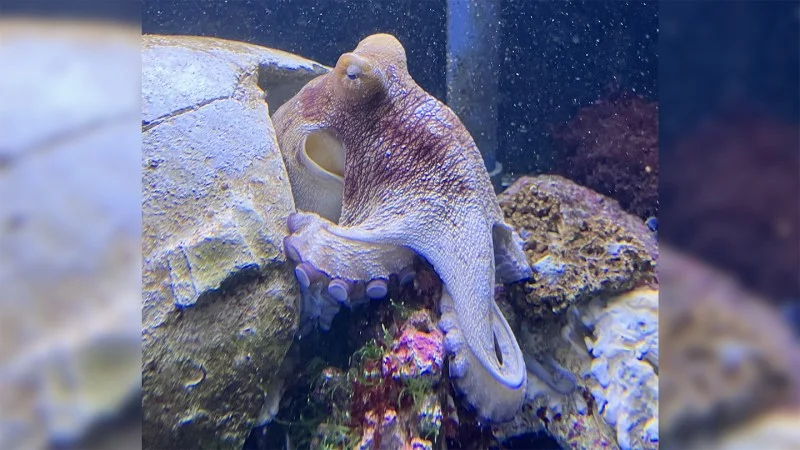
Octopuses don’t just flatten themselves to escape tight spaces. They follow a sequence of moves that changes with the opening’s size, according to experiments with two species published November 5 in the Journal of Experimental Biology. The findings offer soft robotics researchers a closer look at how a flexible body can navigate a narrow passage. They also challenge the simple image of an octopus squeezing through a gap as one continuous act: the animal’s arms, head and mantle appear to take turns negotiating the obstacle.
Michael Kuba, a biologist at the University of Naples Federico II, and colleagues studied three common octopuses (Octopus vulgaris) and four Mayan octopuses (Octopus maya). The team measured the distance between each animal’s eyes as a proxy for the width of the relatively rigid cartilage surrounding its brain. Researchers then placed the octopuses in acrylic boxes fitted with openings slightly narrower or wider than that measurement. This gave the team a reference point for comparing the animals’ behavior with the dimensions of a body part that can’t deform as freely as their arms.
Opening size changes the escape sequence
Common octopuses used a three step maneuver when an opening was wider than the distance between their eyes. They threaded one or two arms through first, followed with a couple more, then pushed against the box with the arms already outside. That leverage pulled the head and remaining arms through in a quick final motion. The escape took only a few seconds. The order matters: the arms that have cleared the opening help move the rest of the animal, turning a narrow passage into a problem of positioning and force as well as flexibility.
For a narrower opening, the common octopuses added another move: they pushed all their arms through before compressing the head and bulbous mantle to follow. Their soft bodies can change shape, but the sequence still has to get the less flexible parts through. That’s a useful distinction. Flexibility gives the animal room to adapt, while the relatively rigid area around the brain sets a more demanding part of the passage.
Different species, different willingness to try
The four Mayan octopuses approached the tighter openings more cautiously. They generally ignored holes narrower than the eye to eye measurement instead of attempting to squeeze through. Kuba suggested their habitat may help explain the contrast: Mayan octopuses live in sandy, rocky areas and may hide beneath rocks without often needing to force themselves through holes. The difference could also reflect other aspects of their biology or adaptation. With only seven animals in the study, the results offer a comparison between these individuals, while leaving open how broadly the pattern applies within either species.
That hesitation is part of the result, not a footnote. An animal’s ability to pass through an opening doesn’t mean it will try, and behavior can reflect the situations it commonly encounters. Escaping through gaps serves practical purposes beyond getting out of a tank: octopuses use their ability to reach concealed food and avoid predators. Robyn Crook, an evolutionary biologist at San Francisco State University who wasn’t involved in the study, said the behavior is familiar to the public but hasn’t been examined systematically in much scientific research. Here’s the thing: a familiar behavior can still be poorly understood when researchers haven’t tracked its steps under controlled conditions.
What the findings could mean for robots
The researchers see potential lessons for soft robotics. Wenci Xin, a robotics researcher at the National University of Singapore, said that understanding how octopuses reshape themselves could help robots enter spaces that are hard to reach. Many robots designed for narrow openings currently use a snake like form, but octopus movement suggests other body configurations may be possible. The study doesn’t provide a ready made design; it offers a way to think about how a machine might sequence its movements when its body has to pass through a constrained space.
This is more significant than it looks. A robot that can change shape still needs to coordinate that change with the order in which its parts meet an opening. If you’re working in this space, the useful question isn’t only how soft a robot can be, but how it can use the parts that have already passed through to guide what comes next. The octopuses’ movements make that sequence visible.
More than one kind of gap
There are still more conditions to study. Crook pointed to slits and tubes as openings that may prompt different movement strategies than the holes used in these experiments. A passage’s shape and length could change which body parts can enter first or how the animal can brace itself; those are questions for further observation, rather than conclusions from this study.
And yet, the existing comparison gives researchers a clear starting point: opening size can be associated with a change in the escape sequence, while species may differ in whether they attempt the tighter passage. Mapping those responses could give designers a broader set of ideas for robots that need to adapt their shape as they move. The next step is detail. More shapes, more movement patterns, and a better understanding of when flexibility is enough—and when an animal chooses not to test it.


Discussion
Sign in to join the discussion.