Defence lawyers seek a judge’s recusal after a court rejects two experts in the Ulm Five case, where the defence argues Elbit’s technology is relevant.

The dispute over expert testimony has become a central fault line in the trial of five activists accused of damaging an Elbit Systems facility in Ulm, Germany. Defence lawyers say the court rejected testimony that could address the site’s alleged connection to Israel’s military operations in Gaza before hearing evidence on that connection. They are seeking the recusal of presiding judge Kathrin Lauchstadt, alleging bias.
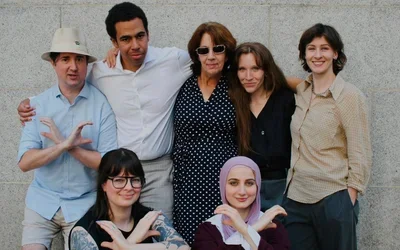
The defendants, known as the “Ulm Five”, are Daniel Tatlow-Devally, Zo Hailu, Crow Tricks, Vi Kovarbasic and Leandra Rollo. They are from Germany, Spain, Ireland and the UK. Prosecutors allege that they entered the Israeli arms company’s Ulm premises on 8 September and damaged the glass facade and office equipment, including computers, screens and telephones. The five have spent more than a year in pretrial detention.
The case concerns alleged damage to a Tactical Data Links (TDL) laboratory at the site. The defence argues that what the facility did matters to understanding the activists’ actions. Its effort to put that argument before the court has so far met resistance.
Two defence experts rejected
On 14 October, the defence presented weapons expert Dr Shir Hever, who was expected to discuss links between technology developed at the Ulm laboratory and Israel’s military campaign in Gaza. After a day of deliberations, the judge rejected the application, reasoning that software developed at the laboratory had no connection to the offensive.
Two days later, the court rejected a second proposed expert, international law professor Isabel Feichtner, who was to give evidence concerning the genocide in Gaza. Defence lawyers told Middle East Eye that applications for other expert witnesses had either received no response or been rejected.
German law obliges a court to hear defence witnesses summoned through a formal application, subject to the court’s ability to reject testimony it considers inadmissible. The defence team therefore brought two witnesses to court in person. Its lawyers say the rejected applications prevent the court from examining technical and legal questions relevant to their case.
Benjamin Düsberg, who represents Tatlow-Devally, called the decision “absurd”. He argued that the court had heard no evidence on the connection between the Ulm site and events in Gaza, and therefore could not already know what an expert witness might establish. Düsberg said the defence was applying for Lauchstadt’s recusal on grounds of bias. Outside court on Friday, he described the proceedings as “a pure show trial”.
The Stuttgart regional court confirmed to MEE that the two defence witnesses had been rejected. It said it had not yet made decisions on the team’s other evidence applications. The court declined to comment on the presiding judge’s conduct or the behaviour of trial participants.

Why the laboratory matters to the defence
Hever described TDL as a network through which Israeli soldiers communicate and share the locations of targets. He said that information is sent to the Nimbus Project cloud, produced by Amazon and Google, and then analysed using artificial intelligence to generate targets at scale.
“So the way that this genocide is happening in Gaza is indeed unprecedented because it can produce targets on an industrial scale,” Hever said. Düsberg argued that the laboratory had been “extremely important for the conduct of this war” and that the defendants’ alleged decision to target the facility should be considered in that context.
Those claims are the defence’s account of the technology and its relevance. The court’s rejection of Hever’s proposed testimony means that, so far, this explanation has not been tested through his evidence in the trial. Düsberg said the court had assumed there was no connection without hearing technical testimony about what was produced at the Ulm site.
The argument puts the purpose of the alleged damage alongside the alleged damage itself. The prosecution case concerns an alleged break-in and destruction of property; the defence is seeking to introduce evidence about the site’s work as part of its account of why the activists acted. The handling of expert testimony will shape how much of that account the court hears.
Dispute over police evidence
The defence has also challenged the scope of the investigation and the evidence given by police witnesses. Lawyers and family members told MEE that officers said they had been instructed by prosecutors not to investigate Elbit’s activities in relation to Gaza. Defence lawyers say police witnesses struggled to answer questions in cross-examination, citing gaps in memory or restrictions on what they were authorised to disclose.
One officer, identified by Mimi Tatlow-Golden, Tatlow-Devally’s mother, as Mr Herold, was tasked with investigating Elbit’s finances. She said he told the court that 38 percent of Elbit’s profits went abroad, but had not investigated where the money went. According to Tatlow-Golden, he said he was not a weapons expert and that the subject was outside his area.
German law requires prosecutors to investigate both evidence that incriminates a suspect and evidence that could support the defence. Nina Oner, who represents Hailu, said the defence repeatedly encountered witnesses who could not answer questions about matters it considered significant. “The witnesses either seem to all suffer from the identical amnesia or refuse to testify by invoking the limitations on their authorisation to testify,” she told MEE.
Oner also said police witnesses had referred to meetings with prosecutors and the involvement of other people, while declining to identify those participants. When defence lawyers asked about possible involvement by the interior ministry or German intelligence services, she said witnesses typically cited confidentiality. Her suggestion that intelligence services were involved is the defence lawyer’s interpretation; the report does not establish that they took part.
Questions about the defendants’ detention
Tatlow-Golden also described testimony from Ms Jager, an investigating officer with the Stuttgart State Criminal Police Office who processed the defendants at Ulm-Mitte police station after their arrest on 8 September. At a hearing on 25 August, she reportedly said she could not recall details of her interactions with the group, including their conditions at the station, whether they requested lawyers and when events took place.
Tatlow-Golden said the five were not read their rights for 12 hours and were denied access to lawyers and contact with family during that period. She said Jager could not remember repeated requests by lawyers to speak with their clients. Tatlow-Devally identified Jager as the officer he had asked for a call to his lawyer and father; according to his mother, the officer replied, “later”. The police office told MEE it does not comment on ongoing investigations.
These accounts come from the defendants’ family and legal representatives, while the court’s response on the rejected experts confirms only those evidentiary decisions and says other applications remain undecided. The next decisions on defence evidence will help determine whether the trial examines the technical role the defence attributes to the Ulm laboratory, alongside the allegations of property damage.


Discussion
Sign in to join the discussion.