Chemical clues in 237-million-year-old fossils suggest Gerrothorax maritimus drank seawater and hunted on the seafloor.
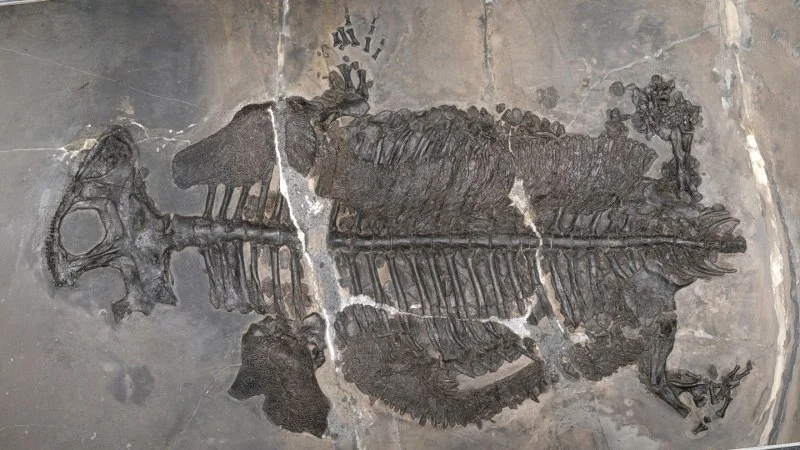
A 237-million-year-old amphibian appears to have made the ocean its permanent home, challenging the assumption that amphibians need freshwater or access to land. Fossils of Gerrothorax maritimus carry chemical evidence that the animal drank seawater and ate marine prey, researchers report October 26 in Nature Ecology & Evolution. The claim rests on more than the fact that its bones turned up in marine deposits: the chemistry inside them offers a way to ask where the animal lived, rather than simply where it ended up after death. That distinction matters when fossils are found far from the environments associated with their closest relatives.
Fossils point to a marine life
Two well-preserved specimens, each about 70 centimeters long, were found in deposits that were once seabed, roughly 30 kilometers from ancient land. That location alone couldn’t show whether the animals lived at sea or washed into the sediments after death. Ryosuke Motani, a paleobiologist at the University of California, Davis, and colleagues compared strontium in the fossil bones with the chemical signature of the Triassic ocean. The match supports the idea that G. maritimus drank seawater and fed in the marine environment. “That means it lived there,” Motani says.
The chemical evidence addresses a basic problem in paleontology: fossils record where an organism was buried, but that isn’t always where it spent its life. An animal could be carried away from its usual habitat before its remains settled. Here, the strontium comparison adds evidence about the animal’s exposure to seawater, giving the marine interpretation more weight than the seafloor setting could provide on its own. It’s still an interpretation built from preserved traces, but it links the site of discovery to the animal’s likely way of life.
The discovery makes G. maritimus the first known amphibian with evidence of life independent of both land and freshwater. The animal lived during the Late Triassic, a period spanning roughly 237 million to 201 million years ago. Its flattened body, upturned eyes and bony armor set it apart from modern amphibians, whose porous skin makes saltwater difficult to tolerate. The contrast is striking: the category’s living members are strongly associated with moist environments, while this extinct animal appears to have crossed a boundary that remains difficult for amphibians today.
“For amphibians, this is the first time that that we have hard evidence that they were actually adapted for long-term life in the sea,” says Lachlan Hart, a paleobiologist at the University of New South Wales in Sydney, who wasn’t involved in the study. Hart and colleagues had previously proposed that another ancient amphibian may have traveled at sea, though probably didn’t live there. The distinction between making a journey and living in the ocean is central here. A temporary marine passage would show that an amphibian could tolerate seawater for a time; evidence of a lasting marine life points to a much larger ecological shift.
Armor and gills may have helped
The fossil animals look much like their closest known relatives, freshwater amphibians. Yet features shared by G. maritimus and those relatives may have helped them cope with a marine existence. Their bony plates likely offered protection, but could also have reduced water loss. They also retained internal gills into adulthood, unlike most modern amphibians, which typically lose those gills after their larval stage. That fishlike breathing system may have suited life below the surface.
These features don’t, by themselves, explain how the animal handled every challenge of living in saltwater. The study’s evidence supports a marine habitat and suggests possible advantages of its anatomy; it doesn’t turn those suggestions into a complete account of its physiology. Still, the combination is informative. Body armor could have served more than one purpose, while adult gills mark a difference in development from the pattern familiar in most living amphibians. A workable marine life may have depended on several traits acting together.
These adaptations matter because the same permeable skin that allows modern amphibians to absorb water also leaves them vulnerable to salt, toxins and disease. No living amphibian is known to spend its entire life in saltwater, despite the more than 8,000 species alive today. The comparison helps explain why G. maritimus is an exception worth taking seriously: its fossil record suggests a marine existence, while the biology of living amphibians makes that existence seem unlikely. That gap is a prompt to look closely at what was different in the extinct animal, rather than assume all amphibians shared the same limits.
A seafloor ambush predator
The fossils also offer a glimpse of how G. maritimus may have hunted. Its jaw could hinge upward, a motion that may have generated suction to pull in fish and other small animals. The body shape and elevated eyes are consistent with an ambush predator lying in wait on the seabed. These clues suggest a feeding strategy suited to the setting: an animal could stay low, watch above it and draw nearby prey into its mouth. A plausible picture, though still a reconstruction from anatomy rather than a record of a hunt.
That feeding possibility also fits the broader evidence that the animal used the marine environment for food, not simply as a place to rest or pass through. The fossils don’t reveal how often it hunted or exactly what it ate. But the combination of a jaw capable of suction feeding and a body suited to the seafloor gives researchers a way to connect anatomy with habitat. (And this is the part most people overlook.) A fossil’s value can lie not only in identifying an animal, but in showing how its body may have worked in an ecosystem.
What the find changes
Paleontologists have found evidence that mammals, reptiles and birds evolved to live in salty environments, but amphibians have remained elusive. “Amphibians were always the problem because they did not really follow the rule,” Motani says. Hart suggests that researchers may have missed marine species by searching mainly in freshwater and terrestrial deposits. Other amphibians could still be waiting to emerge from ancient seabed fossils.
The discovery makes the search strategy itself part of the story. If researchers expect amphibians to be tied to land or freshwater, they may pay less attention to marine deposits that could hold evidence of an unusual life history. That doesn’t mean every amphibian fossil found at sea belonged to a permanent marine resident; the same question raised by these specimens would still need careful examination. But G. maritimus gives researchers a reason to test that assumption against chemical evidence and anatomy, rather than let habitat expectations decide the answer in advance.
If you’re working in this space, the practical implication is a broader set of places to look and a sharper distinction to make: was an animal transported to the sea, or did it live there? The answer could reshape how scientists describe amphibian ecology in the distant past, but the available evidence supports a specific claim about this animal, not a general rule for the group. This is more significant than it looks. One well-supported exception can expose how much a familiar category depends on the living examples we happen to have.
And yet, the discovery leaves open how common such marine amphibians were and how they managed the physiological demands of seawater over a lifetime. The fossils establish a striking case, while further finds may show whether it was unique or part of a wider pattern. For now, the clearest conclusion is also the most restrained: at least one amphibian appears to have lived and fed at sea. A rare boundary crossed.


Discussion
Sign in to join the discussion.