Recent Hubble observations have uncovered a unique decagonal jet at Saturn's south pole, challenging previous understandings of the planet's atmospheric patterns.
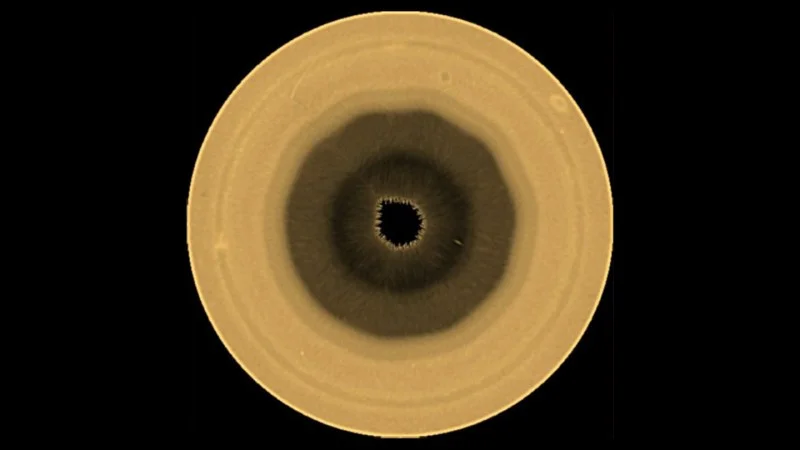
In a surprising turn of events, astronomers have unveiled an unusual ten-sided jet pattern swirling around Saturn's southern pole, a discovery made possible through Hubble Space Telescope observations and collaborative efforts from amateur astronomers. This finding, while unexpected, adds a significant layer to the ongoing study of Saturn's atmosphere, making one question what else might be lurking in the gas giant's clouds.
Contrasting Features of Saturn's Poles
This new feature starkly contrasts with the well-known hexagonal jet that has circled Saturn's north pole for over 45 years, first spotted during the Voyager probes' mission in the early 1980s. The hexagon has been a focal point of Saturn studies, piquing the interest of the scientific community due to its unique geometric shape and seemingly unchanging nature. In contrast, the southern hemisphere hadn’t revealed any analogous phenomena until now, indicating that our understanding of Saturn's meteorological dynamics is still incomplete. The fact that it took more than four decades to detect similar features invites deeper reflection on the atmospheric mysteries that remain unsolved.
The Discovery and Its Implications
Published on September 2 in Science Advances, the findings demonstrate that this decagon was first detected last autumn in Hubble’s images. Upon examining data as far back as 2023, researchers confirmed that traces of this polygon were visible then, though it appeared less defined. The timing of its formation remains uncertain. Saturn's south pole has been turned away from Earth since 2012, suggesting that monitoring atmospheric phenomena can sometimes yield surprises after years of observational gaps. The recent observations shake up previous assumptions about Saturn's atmospheric practices, underlining how much we might still overlook, even when we've been staring at the same giant planet for years.
Revising Our Understanding of Atmospheric Dynamics
Agustín Sánchez-Lavega, a planetary scientist from the University of the Basque Country in Bilbao, comments that the existence of this feature modifies our understanding of the atmospheric dynamics on Saturn. He argues that the hexagon at the north pole might not be as unique as previously assumed. “This discovery suggests that the hexagon is not as extraordinary as previously thought,” he states. The profound implications here shouldn't be brushed aside. If one major atmospheric phenomenon inspires another one so dramatically different, it raises questions about whether our models of atmospheric dynamics on gas giants are fundamentally flawed or are merely incomplete. Scholars could be stepping into a period of re-evaluating what atmospheric patterns truly mean for planetary science.
Variability and Atmospheric Conditions
Interestingly, the decagonal feature exhibits more variability than the stable hexagon observed at the north pole. Amy Simon from NASA’s Goddard Space Flight Center notes that atmospheric conditions on gas giants like Saturn can change rapidly, raising questions about how long this newly identified decagon will persist in the turbulent atmosphere. “Gas giants look nice and serene, but they’re very windy. Atmospheric features can last for decades, but changes can happen quickly,” she explains. The need for continuous observation underscores why space-based telescopes remain vital for studying such dynamic environments. For anyone involved in planetary science, this variability is a reminder that consistency in atmospheric patterns is more the exception than the rule.
Connections to Saturn's Size and Rotation
Despite the unexpected nature of this ten-sided jet, its occurrence is not wholly unprecedented. Wanying Kang, a planetary scientist at MIT who did not participate in the study, remarks that Saturn’s immense size and rapid rotation—approximately 10.7 hours for a full day—are conducive to the formation of various atmospheric jets. She suggests that the decagon's angular structure is compelling and may provide insights into the deeper layers of Saturn's atmosphere. The large scale of Saturn not only enables such phenomena but also presents a challenge: it takes sophisticated technologies and methodologies to unravel what underpins these complexities. The angular features seen in the decagon highlight the dynamic interactions between atmospheric states, storm activity, and rotational forces.
Future Monitoring and Observations
While researchers have yet to pinpoint the exact cause of this unique atmospheric feature, they speculate that it could be influenced by nearby storm activity. Plans to involve additional observatories, including the James Webb Space Telescope, are underway to monitor this jet's development over time. This endeavor is essential for enhancing understanding of its origins and implications for our comprehension of gas giants as a whole. Agencies dedicated to space studies must recognize that the key to unlocking deeper questions lies in sustained observation and collaboration across instruments and disciplines.
Anticipation for Upcoming Discoveries
Upcoming observations from Hubble, slated for later this month, promise further insights into this enigmatic phenomenon, raising anticipation among the scientific community. “We’ll be watching it, and we’ll go from there,” Simon concludes. This investment in monitoring signals an acknowledgment that the mysteries of Saturn are far from solved. The more we learn about its atmosphere, the more we may discover about other gas giants within and beyond our solar system. If you're working in this space, you'll want to keep your eyes peeled. The implications here stretch beyond just Saturn; they may even hint at atmospheric processes on exoplanets, offering a broader perspective on the science of planetary atmospheres across the universe.


Discussion
Sign in to join the discussion.