The abandoned Dreilinden checkpoint still carries Berlin’s divided history, while Angst Yok’s playful signs bring a flash of humor to its fading 1970s architecture.

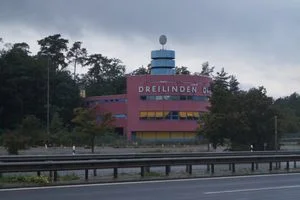
At the former Dreilinden border crossing, Berlin’s history is written across a fading set of bright colors—and, more recently, in two slyly altered signs. The abandoned petrol station canopies now read TUGENDAMT on the outbound side and PIZZARAND on the inbound, turning infrastructure built to manage movement into a place that rewards a second look. Both names look official at first glance, which is part of the joke. Neither is quite what it seems.
A border stop left behind
Designed by Rainer Rümmler and Hans Joachim Schröder, the Dreilinden complex was built between 1968 and 1972. Its buildings included border clearance facilities, a rest stop, two petrol stations and a bridgehouse that served as a customs office, so the site combined the practical needs of travel with the formal business of controlling a crossing. Red, blue and yellow tie the ensemble together in a distinctly 1970s palette. The colors still make the complex legible as a designed whole, even as wear has begun to break it down.
For drivers leaving West Berlin, this was once a final place to refuel before the checks and long waits ahead. Hitchhikers gathered here, and outbound traffic slowed to a crawl, making the station part of the experience of departure rather than simply a place to buy fuel. A stop like this could be ordinary and tense at once: a pause for practical needs set against the uncertainty and delay of a border crossing. Today, the petrol stations stand empty. The customs office in the bridgehouse remains active, though the structure shows little sign of recent upkeep.
The site is protected as a historic monument, but that designation hasn’t stopped visible decline. Paint has faded, blinds hang at an angle, and graffiti marks the station buildings; each detail makes neglect visible at the scale of everyday use. The rest stop has been renovated, yet remains unused—a sharp contrast between fresh work and a site with no daily purpose. That gap matters: renovation can repair surfaces, but it can’t by itself give a building a role or bring people back through its doors.
Signs with a second meaning
The new canopy lettering comes from Angst Yok, an artist collective known for altering abandoned shops, billboards and other urban spaces with messages designed to pass, briefly, as official signage. Here, Tugendamt (“Ministry of Virtue”) riffs on Jugendamt, the youth welfare office, while Pizzarand means “pizza crust.” The altered words borrow the confident, administrative look of public signs and then undercut it with absurdity. The contrast gives the dead petrol stations a comic afterlife, while keeping the intervention tied to the specific shapes and history of the place.
There’s another detail that makes the intervention feel deliberate: the clocks on the station facades are all stopped at five minutes to twelve. Together with the lettering, they give visitors several small clues to read rather than a single explanation of what the site means. The signs don’t restore the complex or conceal its neglect. They give visitors a reason to look twice, and to read the place as more than a relic. That’s a modest form of attention, but it’s more than the empty stations appear to receive in ordinary use.
Humor against the backdrop of history
A Berlin Bear stands between the former stations, greeting traffic on one of the city’s main routes. Seen against the checkpoint’s faded colors and the artist collective’s deadpan wordplay, the bear seems almost amused. The image is funny, but the humor sits beside a complicated history of travel, waiting and border control, rather than erasing it. Dreilinden holds its history, its former spectacle and its visible decay in one frame; the humor on its canopies is the latest layer.
This is more significant than it looks. The lettering doesn’t supply a new official use for the petrol stations, and it doesn’t resolve the tension between preservation and decay. Instead, it changes what a passerby might notice: the architecture, the stopped clocks, or the difference between a building that’s been renovated and one that’s still in use. A temporary joke can make a neglected place newly readable. Briefly.
What the intervention can—and can’t—change
For anyone working in historic preservation or urban design, Dreilinden offers a familiar problem in unusually visible form. A protected designation can recognize a site’s value, while the buildings still face the practical question of who uses them and for what. Similar sites often depend on a balance between maintaining physical structures and finding a purpose that can support regular activity. The source gives no indication that such a purpose has been found here; the contrast between the renovated rest stop and the empty petrol stations is the clearest evidence of the gap.
If you’re passing through, the altered signs make the complex easier to notice, but they don’t tell you how its future will be decided. That remains an open question. The intervention’s strength is narrower: it adds a layer of interpretation without pretending to settle the site’s history or its condition. And yet, that small shift in attention may be the point. Dreilinden’s canopies now carry a joke, while the buildings beneath them continue to show the difference between being remembered and being put to use.


Discussion
Sign in to join the discussion.