Research highlights how exceptional memory helps mountain chickadees survive harsh winters and enhances their mating success.
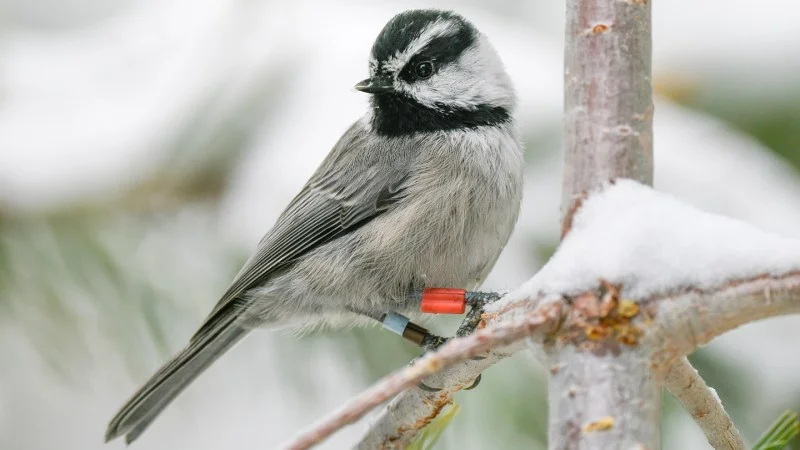
A mountain chickadee navigating the snowy Sierra Nevada cannot afford to waste time. Weighing barely more than a pencil, it must rapidly locate hidden pine nuts to endure the brutal winter conditions. Fortunately, these diminutive songbirds excel at memorizing, with each bird precisely recalling the location of the nearly 100,000 seeds it stored for winter, as revealed by behavioral ecologist Ai Ana Richmond from the University of Nevada, Reno.
Richmond and her team conduct year-round studies in the Sierra, employing both snowmobiles and cutting-edge technology to examine the cognitive capabilities of mountain chickadees in their natural habitat. Their work, centered at the Sagehen Creek Field Station just north of Truckee, California, stands as one of the longest-running studies of animal cognition outside a laboratory setting. Each year, the automated system assesses the memory of up to 250 chicks, uncovering vital insights into the roles of memory in survival, reproduction, and other essential life traits.
Adaptable Memory as Key to Survival
The rigorous winters demand high cognitive flexibility from these birds. Behavioral ecologist Vladimir Pravosudov initiated the chickadee study to deepen our understanding of the critical necessity for strong memorization skills in animal survival. His fascination with avian cognition began during his undergraduate studies in Russia, where he investigated seed-storing behaviors in birds from Arctic regions. His specific focus on mountain chickadees (Poecile gambeli) began in 1999.
Known as a’ni ki in the Shoshone Indigenous Goshiute dialect, these resilient birds locate single seeds hidden in tree bark amidst the harshest conditions, often buried under four or more meters of snow. Approximately two-thirds of them fail to survive their first winter, but those that do can live for a decade or longer. The research team found that the smartest birds are linked to the longest lifespans, with insights published in Science in 2024 – a critical aspect now under further investigation as to the implications of such longevity.
These groundbreaking findings stem from the creation of unique arrays of feeders in 2013, designed specifically to assess spatial memory in wild chickadees. Each feeder operates on technology akin to hotel room key cards, programmed to open exclusively for designated banded birds, effectively monitoring each bird's feeding habits.
Memory Studies Yield Valuable Insights
The complexity of these memory studies has expanded understanding of cognitive capabilities among chickadees, revealing that genetics account for about 80 percent of observed cognitive differences. Richmond is also exploring whether gut microbiomes, identified through fecal samples of 41 birds, could influence cognitive functioning. Her preliminary findings suggest that birds with superior spatial memory possess a higher population of bacteria producing short-chain fatty acids, potentially beneficial for cognitive health.
Experts caution against overstating these connections. Anya Parks, an evolutionary psychologist, underscores the need for more comparative research to clarify the true impact of the microbiome on cognition. As memory decline is a common phenomenon across many animals, particularly humans as they age, Richmond's research is pioneering the study of this relationship in avian species, with implications potentially extending to understanding memory preservation mechanisms in aging populations.
Cognition and Mating Success
Broader implications of these studies also include understanding how cognitive skills relate to mating success. Carrie Branch, now at Western University, has looked into the relationship between male cognitive abilities and their reproductive strategies. Her research indicates that smarter males are more successful in mating both within and outside their pair bonds, suggesting that females may seek out males with greater cognitive prowess to ensure genetic advantages for their offspring.
It remains a mystery how females discern the intelligence of their mates. Some evidence suggests that these males may signal their smarts through increased singing, an area that researchers are keen to explore further. Pravosudov aims to link various behavioral studies to create a comprehensive understanding of chickadee behavior, asserting that insights gained could have broader applications beyond just their species.
At 65, Pravosudov’s enthusiasm for studying chickadees remains palpable. “I just love being in the field,” he affirms, echoing the passion that fuels ongoing research in understanding the intersections of memory, cognition, and ecology in these captivating birds.


Discussion
Sign in to join the discussion.