Scientists have recreated the songs of Jurassic katydid ancestors, revealing how these insects communicated 165 million years ago.
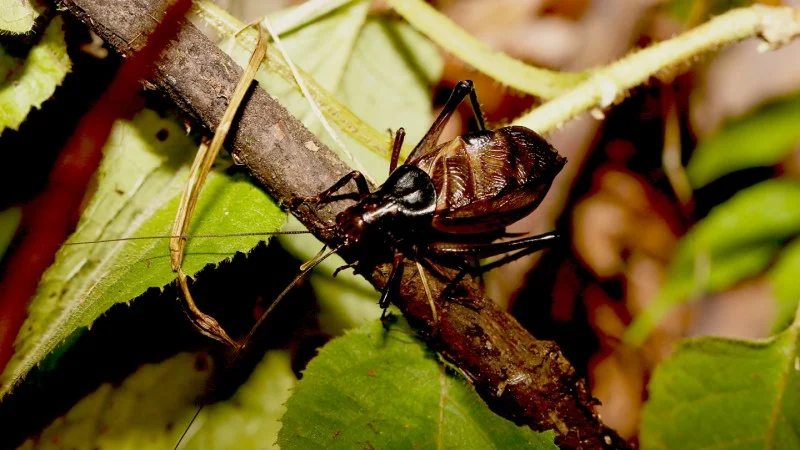
A fascinating glimpse into the prehistoric world reveals that a chorus of katydid ancestors once filled the Jurassic rainforest with musical sounds. Recent research has successfully reconstructed this ancient soundscape, offering insights into communication methods of these early insects.
Based on fossil analyses, a team of researchers demonstrated how these insects produced sounds by strumming their wings, as detailed in a study published on August 25 in the Proceedings of the National Academy of Sciences.
Jun-Jie Gu, an evolutionary biologist from Sichuan Agricultural University in Chengdu, China, remarks, “Most fossils offer insights into anatomy—shape, size, structure. But these fossils preserve something far more ephemeral: sound.”
The fossils, which originated from Daohugou, China, indicate a lush, humid environment during the Jurassic Period, around 200 to 145 million years ago. This region thrived with an array of insects, especially ensiferans, which include katydids, crickets, and grigs.
The team found wing structures critical for producing mating calls, likening them to “nature’s violin.” One wing featured a unique row of microscopic teeth, and as the wings closed, a scraper on the opposing wing passed over these teeth, generating vibrations that resonated through the wing structure. This vibration forms what the researchers classify as a syllable, the fundamental unit of sound, with songs produced through rhythmic opening and closing of the wings.
The fossil study encompasses 20 specimens representing nine extinct species. The researchers simulated wing acoustics by analyzing the spacing of the teeth, the size of the wings, and areas capable of vibrating. Additionally, they constructed an evolutionary family tree to estimate the calling frequencies of each species based on this research. To validate their methods, they replicated the calls of contemporary katydids and crickets using photographic analysis of their wings, confirming the feasibility of extracting sounds from fossilized evidence.
While the physical syllable structure of sound is identifiable, details about the cadence aren’t preserved in the fossils. Thus, the researchers drew parallels from living ensiferans, where the call patterns relate to body size and temperature. A machine learning model was trained using these characteristics, which, together with the estimated climate of the ancient rainforest, facilitated the simulation of the insect calls. The outcome was a remarkable reconstruction of katydid ancestor calls.
This research excited paleobiologist Roy Plotnick from the University of Illinois Chicago, who commented on the novel ability to define distinctive sounds among different species, likely employed for mate recognition.
Scans of the insects’ auditory systems, located on their forelegs, support the hypothesis that these ancient creatures could detect sounds unique to their species.
The reconstructed calls from these ancient insects are melodious, contrasting with the buzzing or hissing of many modern insects, which encompass multiple frequencies. Such single-note tones could provide a tactical advantage against predators, making them harder to trace, as noted by biophysicist Daniel Robert from the University of Bristol.
Intriguingly, one ancient species was found to emit ultrasonic calls, predating the evolution of bats, which have since adapted to caw above the human hearing range. Meanwhile, other findings concerning early mammals within the same geological formation in China indicate that their auditory capabilities may have included recognition of these katydid forebearers' calls. This suggests a fascinating evolutionary interplay, as insects may have adapted to elude predators that were also evolving heightened hearing abilities.
Zhe-Xi Luo, a paleobiologist at the University of Chicago, remarked on the stimulating implications of these findings, acknowledging the need for further study to verify these hypotheses. Luo's team continues to explore early mammal auditory systems to deepen our understanding of these interspecies dynamics.
In summary, while much still remains to be discovered regarding the prehistoric soundscape and even earlier eras, this research symbolizes a burgeoning recognition of the auditory histories embedded within fossils. “We often assume fossils are mute relics,” Gu reflects, “but our study illustrates that we can listen to the conversations of animals from 165 million years ago.”


Discussion
Sign in to join the discussion.