Galerina indica makes a psychedelic compound and a newly identified amatoxin, revealing unexpected chemical diversity in fungi.
A rare find with an unexpected chemistry
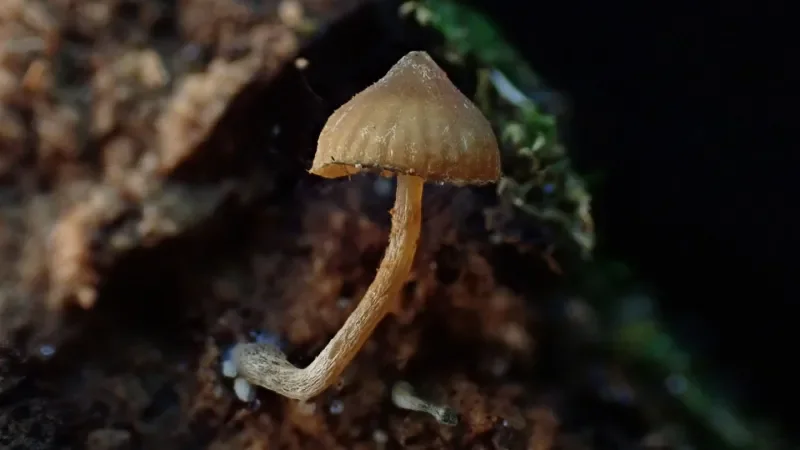
A tiny Florida mushroom carries an unusual chemical combination: the psychedelic psilocybin and a newly identified amatoxin that can be deadly in small amounts. The discovery in Galerina indica challenges the assumption that fungi generally produce one type of compound or the other. It also shows why a mushroom’s visible traits can be a poor guide to what it contains: chemistry that matters greatly to people may be impossible to infer from a small cap or a patch of blue bruising.
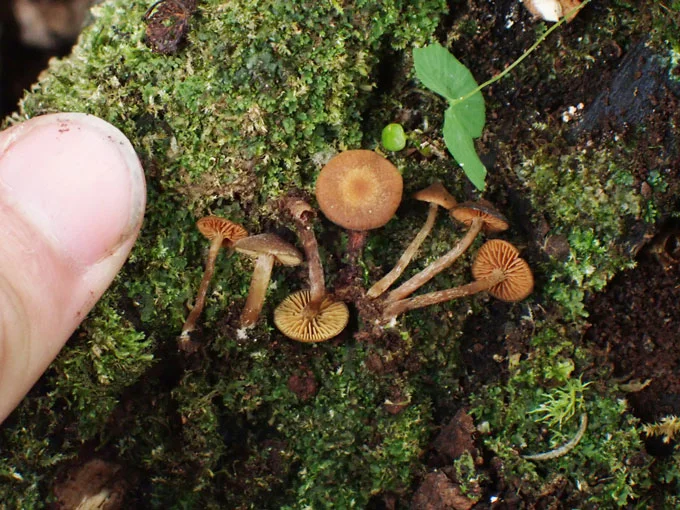
Andrew Kunik discovered the mushroom in 2025 on a decaying, moss-covered palm trunk in a central Florida wetland. At the time, he was conducting post-baccalaureate research in fungal biologist Matthew Smith’s lab at the University of Florida in Gainesville. The species had not previously been reported in Florida. Finding it in a wetland on dead plant material gives researchers a point of reference for its habitat, though a single discovery doesn’t establish how common the species is or where else it may occur.
Kunik and colleagues also found two related species that they provisionally named Galerina species 1 and Galerina species 2. Their chemical analyses showed that G. indica produces a previously unknown amatoxin, which the researchers named alpha-proamanitin. Related Galerina mushrooms are known to make amatoxins, compounds also found in death caps and other fungi. The new compound adds to that family of toxins, while raising a separate biological puzzle: why one species makes it alongside a psychedelic.
Blue bruising on G. indica suggested that it might contain psilocybin. The team confirmed that it produces the psychedelic alongside alpha-proamanitin, making it the first known fungus with both classes of compounds. Species 1 also produces psilocybin but lacks amatoxin; species 2 makes neither. This comparison matters because the three fungi provide clues about how chemical traits are distributed among close relatives. Their differences don’t, by themselves, explain what each compound does for the mushroom.
Andrew R. Kunik
“This finding shows that there’s a lot more diversity in [fungal] chemistry and the ways that they’re combined than we had really thought about,” says Anne Pringle, a mycologist at the University of Wisconsin–Madison who wasn’t involved in the research. That’s a useful correction to any tidy picture of fungal compounds as neatly separated into categories. The surprise is the combination itself.
Genes point to a tangled evolutionary history
DNA analysis found genes associated with production of both compounds in G. indica. The researchers propose that its ancestors acquired some of these genes through horizontal gene transfer, in which organisms gain genetic material from other species. The process can quickly give organisms new traits; bacteria, for instance, can exchange genes linked to antibiotic resistance. In fungi, the possibility offers one explanation for how a lineage might gain a chemical capability without inheriting it through the usual sequence of parent-to-descendant transfer.
Amatoxin genes appear to have entered the ancestry of G. indica and its relatives early. Many of its cousins also produce these toxins, suggesting they inherited the genes from a common ancestor. The lineages leading to species 1 and species 2 may later have lost the amatoxin genes. That pattern is a reminder that evolutionary history isn’t simply a matter of accumulating new traits: lineages can also lose genetic machinery over time.
The path of the psilocybin genes is less clear. The ancestors of G. indica and species 1 may have acquired them in separate DNA transfers, or a shared ancestor may have gained them and passed them on. The available family tree isn’t detailed enough to distinguish between those possibilities. Either way, the contrast among the three species gives scientists a starting point for asking when the genes appeared and how their presence relates to the fungi’s chemistry.
That uncertainty is part of the result, not a flaw to paper over. A gene’s presence can point researchers toward a possible history, but relatedness and gene transfer can be difficult to untangle when the family tree lacks enough detail. The evidence supports more than one account. Resolving which account fits would require a clearer view of the relationships among these fungi and their relatives.
What the mushroom’s toxins are for remains unclear
Why mushrooms produce toxins is still an open question. Poison may help defend fungi from predators, Pringle says, but researchers lack strong evidence for that explanation. The idea is plausible, yet the presence of a toxin doesn’t establish its purpose; demonstrating a defensive role means connecting the chemistry to an effect on organisms that encounter the fungus.
For people who find an unfamiliar mushroom, the discovery adds a sharp reason for caution: appearance alone can’t reveal its chemical contents. Blue bruising helped point researchers toward psilocybin, but it didn’t disclose the presence of alpha-proamanitin. If you're working in this space, that gap between visible clues and chemical evidence is a practical reminder to treat identification and chemical analysis as different questions. A striking feature can guide an investigation; it can’t settle what’s safe.
Psilocybin may be studied for mental health treatments, but G. indica also makes a toxin capable of causing fatal poisoning. This is more significant than it looks: the discovery complicates the assumption that a fungus associated with one notable compound can be understood through that compound alone. And this is the part most people overlook: the mushroom is tiny, but its chemistry doesn’t fit a simple label. For now, the evolutionary route of its genes and the biological purpose of its toxins remain open questions. Kunik’s caution applies to the science as much as to mushroom collecting: “Surprising discoveries require great depth of evidence.”

Discussion
Sign in to join the discussion.