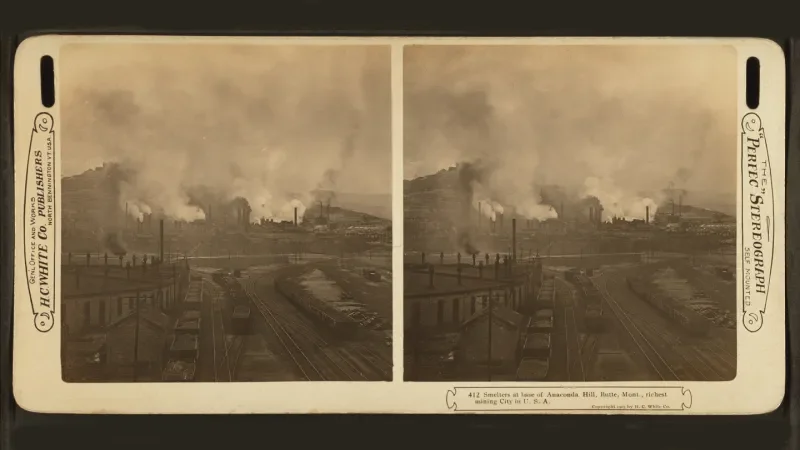
Arctic ice records point to a Montana copper smelter as a major source of arsenic pollution from 1870 to 1914, with emissions peaking at an estimated 30 tons daily.
Ice cores preserve a distant pollution record
Arctic ice preserves evidence of industrial pollution at a scale that’s difficult to reconstruct from records on the ground. New analysis links sharp rises in arsenic deposited between 1870 and 1914 to a large copper mining and smelting operation in southwestern Montana. The finding shows how pollution from a specific industrial source can leave a trace far beyond the communities closest to it.
That reach matters because historical records tend to describe what people saw locally: smoke, damaged crops, sick animals, or complaints about a nearby facility. Ice cores offer a different kind of evidence. They preserve airborne particles that traveled long distances and settled over time, creating a record that can be compared across locations and periods.
Joseph McConnell, an environmental scientist at the Desert Research Institute, and colleagues examined 10 ice cores collected across Canada, Greenland and Russia. The cores preserve airborne material deposited as far back as 210 BCE. In layers from the industrial period, arsenic levels reached as much as 15 times preindustrial concentrations.
That comparison gives the reported increase a historical baseline. It doesn’t, by itself, identify the source: arsenic can come from different activities, and a concentration in ice is a record of what arrived there, not a direct measurement of emissions at a smokestack. The researchers’ case depends on bringing together the timing, the geography, the industrial history and atmospheric models.
Greenland points to a North American source
The strongest arsenic increases appeared in Greenland. That pattern helped the researchers narrow the source: atmospheric circulation generally carries material from west to east, so emissions from North America could explain the Greenland signal. A European source would likely have produced larger increases in the Russian Arctic, McConnell said.
This is a geographic argument, not a fingerprint that names a polluter on its own. The distribution across multiple cores helps test whether a proposed source fits the observed pattern, while atmospheric circulation provides a plausible route for the emissions. Taken together, those clues make the North American explanation stronger than one based only on the presence of a large smelter.
The team identified the Anaconda Copper Mining Company as the most likely emitter. Its operation was among North America’s largest during the period, and its copper ore contained arsenic and lead. The findings were reported November 3 in Nature Sustainability.
“Most likely” is a careful phrase. The evidence ties the Arctic signal to a likely source through several lines of analysis, but the source description doesn’t claim that every unit of arsenic in the cores came from this company. That distinction matters when an environmental record is being used to connect a distant industrial operation to pollution across a region.
Historical accounts describe the pollution’s local effects. Fred Quivik, a historian and author of Smoke and Tailings, said ranchers and farmers began reporting livestock deaths from arsenic poisoning. The metals were entering the atmosphere while the smelter operated, he said.
The local accounts add human and economic context to the measurements. They suggest that the pollution was not just an invisible signal in remote ice: people living near the operation were reporting harm during the period of emissions. Still, reports of livestock deaths and the ice-core record answer different questions. One documents reported effects near the smelter; the other tracks airborne material reaching distant places.
Controls reduced emissions, after years of exposure
By combining ice-core measurements with atmospheric dispersion models, the researchers estimated that the company released about 30 tons of arsenic a day in the late 19th and early 20th centuries. Chile, now the world’s largest copper producer, emits roughly one quarter of that amount today across more than 20 mining operations.
The comparison gives the historical estimate scale, but it needs to be read with care. The Montana figure describes one company’s estimated emissions during a particular period; the Chile figure covers more than 20 operations today. They aren’t identical industrial settings, and the comparison doesn’t establish that the pollution reached the same people or places. It does show why the historical operation stands out in the researchers’ account.
In 1919, the company began installing equipment near smokestacks and other facilities to capture arsenic. Ice-core data indicate emissions then fell by about 60 percent. The reduction came after nearby residents had already been exposed for decades, and McConnell said the company delayed installing the controls by about 10 years.
The timing makes the decline important, but it also sharpens the question of when controls arrive. A drop in emissions is visible in the environmental record; it doesn’t erase what happened before the change or show, on its own, how exposure varied among nearby residents. For communities affected by industrial pollution, that gap between a documented reduction and a documented health outcome is often where the harder historical work begins.
What the record can—and can’t—tell us
Arsenic exposure has been associated with lower IQ and increased rates of some cancers. The researchers say census records could help epidemiologists investigate how the historic pollution affected people in the 19th and 20th centuries. The ice provides a record of where and when emissions reached the Arctic; linking that record to human outcomes is the next step.
This is more significant than it looks. A remote ice core can help reconstruct the reach and timing of emissions, but it can’t establish an individual person’s exposure or prove that a particular illness resulted from the smelter. Census records may help researchers ask better questions about people who lived in affected areas, though linking population records to a changing pollution history will require careful analysis.
(And this is the part most people overlook.) Evidence that emissions fell after controls were installed doesn’t tell us how quickly health risks changed for people who had already been exposed. The pollution record and the human record have to be examined together.
If you’re working in this space, the study’s value is in the connection it builds between industrial activity, atmospheric transport and a preserved environmental signal. The next step is difficult, but clear: test whether the documented pollution history aligns with patterns in historical population records. A long trail in the ice. A harder trail through people’s lives.



Discussion
Sign in to join the discussion.