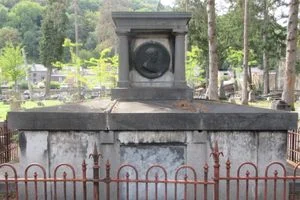
Diguette Cemetery in Angleur holds the family tomb of Georges Nagelmackers, whose determination helped bring the Orient Express to life.
A railway pioneer at rest in Angleur
A quiet cemetery in Angleur holds the remains of a man whose name is far less familiar than the train he created. Georges Nagelmackers, founder of the Compagnie Internationale des Wagons-Lits and the original Orient Express, is buried in the family tomb at Diguette Cemetery. The contrast is striking: the service became a byword for long-distance rail travel, while its founder’s story is less likely to be recognized by the people who know the train’s name.
Angleur sits in southern Liège, between Sart-Tilman Hill and the railway lines of the Ourthe Valley. It’s mostly residential, though two castles stand among its houses: Château Péralta and Château Nagelmackers. The Nagelmackers family bought the latter in the 19th century and donated land in 1864 for the town’s new cemetery. Their family grave is there, too, tying the railway story to a local family history that predates the famous route.
That connection makes Diguette more than a place to mark the end of Nagelmackers’s life. The cemetery sits in the community where his family had property and influence, while the railway lines nearby evoke the infrastructure his work would depend on. A quiet setting. A much larger story.
An idea tested far from home
Nagelmackers’ path to the sleeper train began with a family dispute. In 1867, after he said he wanted to marry his cousin, his father sent him to the United States. There, he took an interest in George Pullman’s night trains and spoke with passengers about how the service might be improved. The episode put him close to a form of travel that was still being worked out: how to make an overnight rail journey more comfortable and practical for passengers.
Back in Belgium, Nagelmackers was put in charge of the family’s blast furnaces and mine. He kept working on his plans alongside those duties. In April 1870, he published a brochure explaining the concept; it used the term “wagon-lit,” or sleeper carriage, for the first time. The Franco-Prussian War broke out that July, bringing the project to a halt. His family also opposed the venture and withdrew its financial support.
Those setbacks show the gap between a promising travel idea and a business capable of operating it. A sleeper service needed more than a comfortable carriage: it depended on financing, cooperation across rail networks and passengers willing to pay for a different kind of journey. Nagelmackers had a plan, but he still had to persuade powerful backers and secure the conditions to put it on the tracks.
Support from King Leopold II helped Nagelmackers get a sleeper carriage running between Paris and Vienna in November 1872. The inaugural trip went well, but money troubles soon returned. While seeking funds in London, he met American Colonel William D’Alton Mann, who had patented a different sleeping-car design without finding a market for it. Their meeting brought together two men with related ideas and a shared commercial problem: how to turn a design into a service that could attract both capital and attention.
From sleeper cars to the Orient Express
The two joined forces, founding Mann’s Sleeping Carriage Company on 4 January 1873. Their carriages placed compartments along a side corridor, with toilets at the end—a layout still used in sleeper trains. That arrangement gave passengers private spaces while preserving a passage through the carriage, a practical design choice that helped make overnight travel feel more organized. Mann arranged for the Prince of Wales, later King George V, to travel in one on the way to his brother’s wedding in Saint Petersburg. The trip drew attention to the company and helped it gain an early foothold.
Public attention could help establish credibility, but it couldn’t by itself settle the larger challenge of running a service between cities and countries. The venture had to build on its early notice, win support and establish a business with reach beyond a single route. On 4 December 1876, Nagelmackers and Mann established the International Sleeping Car and European Express Company. Leopold II had contributed money, so the company’s logo included the two lions that flank Belgium’s national coat of arms.
The partnership changed in 1883 when Mann returned to the United States and sold his shares to the king. Nagelmackers extended the Paris–Vienna service to Constantinople, then named the route the Orient Express. Constantinople would not be called Istanbul until 1930; the new line, meanwhile, would become his defining legacy. The route’s name gave the service a strong identity, but the underlying achievement was the effort to connect distant destinations through a coordinated passenger journey.
This is more significant than it looks: the Orient Express became famous as a train, yet its creation also depended on patient work in design, financing and partnerships. If you’re working in this space, that distinction still matters. A memorable product name can capture public attention; operating a service across a network takes sustained organization behind the scenes (and this is the part most people overlook).
A final resting place in Angleur
Nagelmackers died on 10 July 1905 at his château in Villepreux, near Versailles. After his funeral, his body was returned to Belgium and buried at Diguette Cemetery. The grand family tomb stands in a modest neighborhood cemetery, a reminder that the story of the Orient Express leads back to Angleur—and to a railway pioneer whose name has largely faded from public memory.
The grave offers a local point of entry into a history that’s often told through the train itself. Its setting links Nagelmackers to his family’s land and to the town where the family supported a cemetery for residents. The service he helped establish reached far beyond that neighborhood, but the monument brings the story back to a specific place and a life shaped by both family circumstances and commercial ambition.
What the legacy leaves behind
Nagelmackers’s career suggests that transport history is rarely made by a single design or celebrated route. Ideas need backers, workable arrangements and a way to earn public confidence. His experience also shows how easily a founder can recede while the product remains familiar: the Orient Express kept its name in public memory, while the man behind it became harder to place.
That said, the history presented here doesn’t answer every question about how the company operated or how passengers experienced the service over time. It does establish the essentials: an idea shaped partly by observation in the United States, a series of financial and political hurdles, and a partnership that helped bring the sleeper carriage business into being. For visitors to Diguette Cemetery, the tomb makes that broad story tangible. And Angleur becomes part of the route’s history, even if it was never the destination that made the train famous.



Discussion
Sign in to join the discussion.