A Palestinian petition urges Britain to confront its colonial record as the government condemns settlement abuses and marks 109 years since the Balfour Declaration.
Britain’s recent condemnation of settlement violence in the West Bank has sharpened a question the government has yet to answer: what responsibility does it accept for the colonial policies that helped shape Palestinians’ dispossession? A 400-page petition submitted to ministers more than a year ago sets out the case. It remains unanswered.
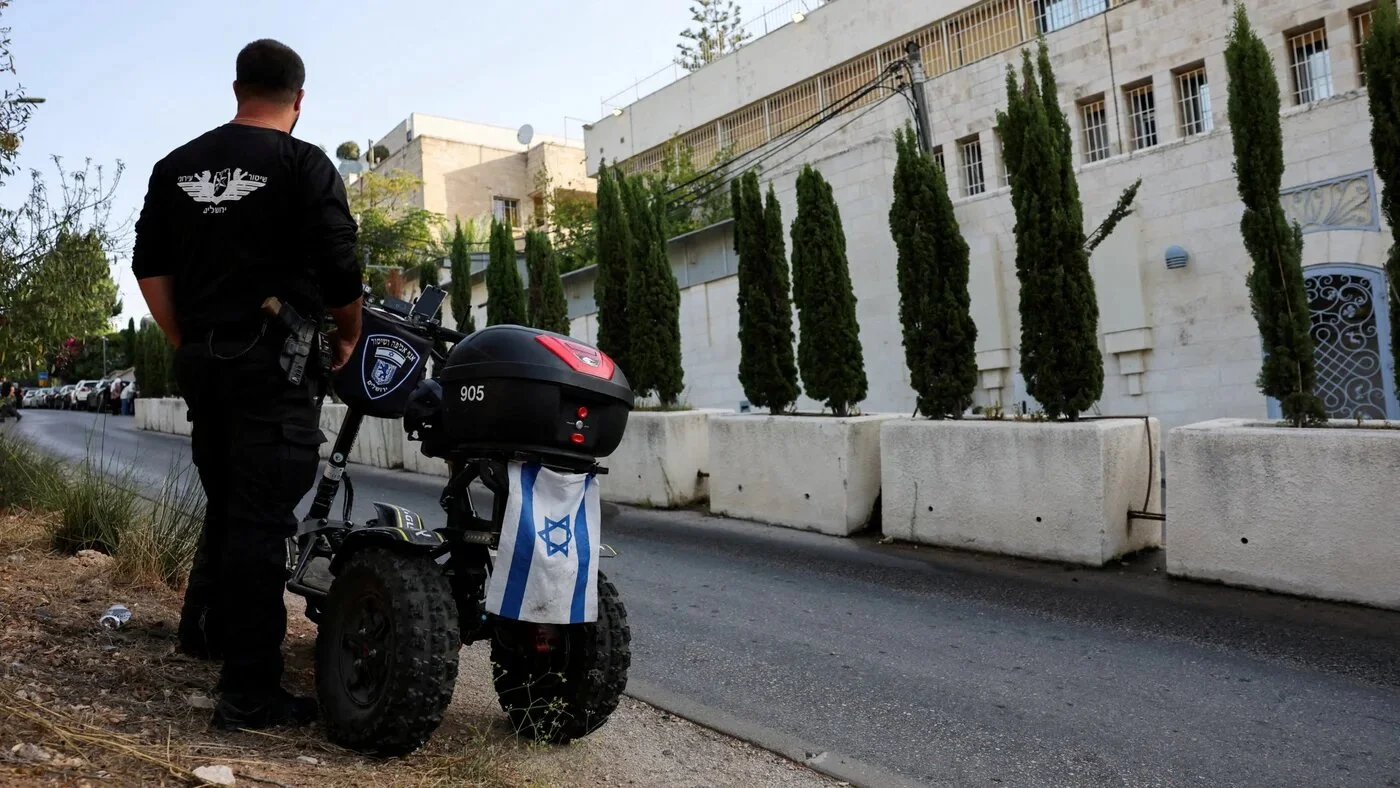
The timing is hard to ignore. On 8 October, workers removed the “British Consulate General” sign from the UK’s East Jerusalem mission after Israel ordered the consulate closed in retaliation for British sanctions on West Bank settlements. The mission was reduced, ending a diplomatic presence Britain had maintained in the city since the 1830s—through Ottoman rule, Britain’s own rule from 1917 to 1948, and decades of Israeli occupation.
Announcing the sanctions, Foreign Secretary Ed Miliband told the Commons that settlers were carrying out the ethnic cleansing of Palestinians. That direct language marks a shift in British public statements. Yet the government’s condemnation sits alongside a long record in Palestine that it has not fully acknowledged.

A Jerusalem municipality officer stands outside the British consulate in East Jerusalem on 8 October 2026, the deadline Israel set for its closure in retaliation for UK sanctions on settlements (Ammar Awad/Reuters)
The promise in the declaration
The Balfour Declaration, issued on 2 November 1917, pledged British support for “a national home for the Jewish people” in Palestine. Its wording also said that nothing should prejudice “the civil and religious rights of existing non-Jewish communities in Palestine.” Those communities—Muslim and Christian Arabs—made up about 90 percent of the population.
Britain did not honor that safeguard. In a private 1919 memorandum, Foreign Secretary Arthur Balfour said the government did not intend to consult Palestine’s inhabitants. Zionism, he wrote, carried greater significance than “the desires and prejudices of the 700,000 Arabs who now inhabit that ancient land”.
The gap between the declaration’s stated protection and British policy widened. The League of Nations Covenant provisionally recognized Palestine’s Ottoman Arab community as an independent nation, to be supported until it could govern on its own. But for nearly 30 years, the Arab majority had no elected or representative governing body. When a limited legislative council was proposed in the mid-1930s, Westminster rejected it.
Emergency rule and its consequences
Britain’s response to the Palestinian revolt that began in 1936 relied on emergency powers. District commissioners could imprison people without trial for a year and renew the orders indefinitely. Authorities imposed fines on entire villages in money, livestock and crops for offenses residents had not been shown to have committed.
The military destroyed much of Jaffa’s old city. Possessing or firing a weapon could bring a death sentence, and military courts executed rebels. By the revolt’s end, about 5,000 Palestinians had been killed. Historian Walid Khalidi estimated that one in ten adult Arab men had been killed, wounded, imprisoned or exiled.
Many of the methods Britain now condemns in the West Bank, including collective punishment and house demolitions, began under British emergency law
When the Nakba unfolded in 1948, Palestinian society had already lost much of its leadership, with many leaders held in detention facilities overseas. British troops stood by during the ethnic cleansing; some also took part in looting Palestinian property. Emergency regulations introduced under British rule remain in use today.
A petition and a precedent
In September 2025, the Britain Owes Palestine campaign submitted its 400-page petition to UK ministers. Drawing primarily on British archival records, it documents alleged misconduct during colonial rule and asks the government to address that history. The campaign says it is still waiting for a reply.
There is a precedent for a formal response. In 2013, Foreign Secretary William Hague told the Commons that the government sincerely regretted the torture of Kenyans during the Mau Mau uprising in the 1950s. More than 5,000 survivors received compensation. For the petition’s authors, that episode shows that an acknowledgment of colonial wrongdoing can coexist with a strong public standing.
The petition calls on the government to assess the evidence, release any remaining historical records and acknowledge Britain’s wrongful acts in Palestine. It also urges the prime minister to apologize publicly in the House of Commons and begin a process to determine appropriate reparations and investment in the Palestinian people and their state.
An apology would not reverse history or settle the present crisis. But as the Balfour Declaration reaches 109 years, a substantive answer to the petition would show whether Britain is prepared to address the harm its policies helped cause.
The views expressed in this article belong to the author and do not necessarily reflect the editorial policy of Middle East Eye.

Discussion
Sign in to join the discussion.