A network of galleries on Washington’s H Street pairs self-taught artists’ work with curious artifacts, including a Silver Slipper from a notorious nightclub.
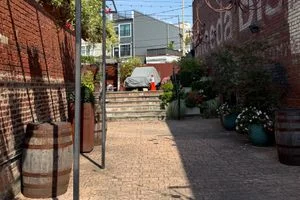
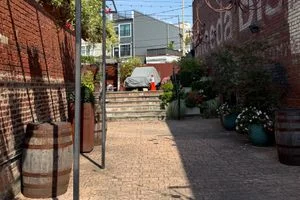
Gallery O on H makes a case for treating a building as part of the collection. Behind a row of ordinary-looking houses on Washington’s H Street, connected rooms, a garage, and a courtyard put paintings and sculptures alongside the objects and histories that inspired them. The setting changes how the work reads: instead of encountering each piece in a neutral white room, visitors move through a domestic-scale collection where art shares space with traces of everyday life. The result feels less like a standard gallery visit than a slow tour through one collector’s unruly archive. That looseness is the point, though it asks visitors to bring their curiosity rather than follow a clear exhibition route.
Art made from what’s left behind
Much of the work centers on self-taught artists, including several with ties to New Orleans, who turn everyday and discarded materials into subjects. Dr. Bob Shaffer, for instance, began painting folding chairs after Hurricane Katrina. A group that started with six chairs at Gallery O on H has grown to 75, depicting New Orleans musicians, local traditions, H Street, and people from the neighborhood. The chairs carry a practical association with gathering: they’re made to be moved, arranged, and occupied. Painted with local figures and scenes, they become records of community life as well as functional objects.
That shift from use to representation runs through the collection. The materials aren’t just a novelty or a visual shortcut; their previous lives give the work a connection to places, people, and routines. A folding chair, a crate lid, or a plastic bucket arrives with a history of ordinary use, and the artists redirect that history without hiding the object’s origins. It’s a grounded way to make art, and one that gives the finished pieces a different kind of presence from work made on conventional surfaces.
Other artists take similarly direct routes from material to image. Tennessee’s Danny Hoskinson, known as “The Bucket Man,” uses a blowtorch to reshape discarded plastic paint buckets into creatures, masks, and sculptures. French artist Joanathan Bessaci builds portraits of George Washington and Abraham Lincoln from cut and layered vintage road maps. New Orleans artist Sainte James Boudrot paints archival obituary notices onto salvaged wooden crate lids, bringing the stories of ordinary people into view. Each approach changes the source material’s function: a bucket becomes a figure, a map becomes a portrait, and a crate lid becomes a surface for remembrance. The methods differ, but the work repeatedly asks viewers to look again at what they might otherwise overlook.
Washington history in the collection
The gallery’s objects carry their own histories. One is a silver slipper from the original Silver Slipper nightclub, once a popular meeting place for Capitol Hill insiders. The club became part of a notorious Washington episode in 1974, when burlesque performer Fanne Foxe—then having an affair with Congressman Wilbur Mills—jumped into the Tidal Basin after police stopped their car near the Jefferson Memorial. The slipper gives that story a physical point of contact. It’s a small object with a larger public history attached, and its presence makes the boundary between artifact and artwork feel less fixed.
That artifact sits among work that connects the gallery to other places and cultural histories: Charles Gillam’s carved portraits of New Orleans musicians, Purvis Young’s expressive paintings of Miami’s Overtown neighborhood, and Ike Morgan’s portraits of American presidents. These works bring distinct subjects into the same rooms, where visitors can make their own connections between local memory, political imagery, and artistic practice. The arrangement doesn’t need to claim that all the pieces share one story. Their proximity is enough to prompt questions about whose histories are preserved, and how objects can carry those histories into a new setting.
Works by several artists represented at Gallery O on H are also held by major museums, including the Smithsonian American Art Museum. That institutional recognition provides one point of context, but the gallery’s presentation offers another: here, the work sits within a dense mix of objects and references. This is more significant than it looks. It suggests that a visitor can encounter artists with museum collections behind them in a setting that foregrounds material, biography, and place rather than polished separation.
A visit without a set route
For more than 15 years, Gallery O on H has occupied a distinctive spot on the H Street corridor. Its rooms don’t follow the usual exhibition format. Art appears around corners and among objects, with the garage and courtyard part of the experience. That wandering layout is central to the appeal: each turn brings another collision of artistic invention, salvaged material, and a fragment of the city’s past. There’s no single sightline that explains the whole collection at once, so the experience depends on noticing how one room’s objects echo or interrupt the next.
That freedom has a tradeoff. A visitor who expects a tightly guided sequence may find the abundance harder to parse, especially when artworks and historical objects occupy the same visual field. But the informal arrangement also suits a collection built around personal associations and reused things. It lets the building function as more than a container: the garage and courtyard extend the visit into spaces that a conventional gallery might treat as back-of-house or simply leave out. And yet, the lack of a set route can make attention feel earned rather than directed. A pause, a turn, a second look.
What the collection makes visible
Gallery O on H’s most persuasive idea is that art doesn’t have to be separated from the lives and materials around it to be taken seriously. The painted chairs and transformed buckets make that case through their physical forms, while the Silver Slipper and the artists’ references to specific communities add historical texture. The collection brings together different kinds of evidence: handmade objects, depictions of people and places, and artifacts linked to Washington’s past. Its strength lies in letting those elements sit together without flattening their differences.
If you’re working in this space, the gallery offers a reminder that presentation shapes interpretation as much as a wall label can. A domestic setting can make collecting feel personal, but it also places more responsibility on visitors to decide what deserves attention. That’s a productive tension. The visit asks you to move slowly, follow your own associations, and consider how discarded materials can hold stories after their original use has ended.



Discussion
Sign in to join the discussion.