Reopened in April 2025, Barryscourt Castle preserves evidence of medieval family life, military conflict and Ogham graffiti.
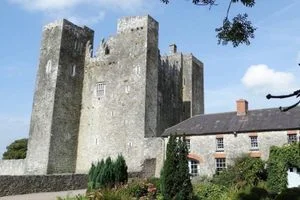
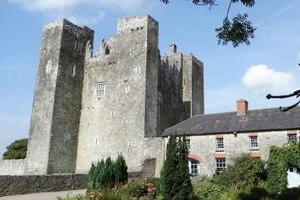
Barryscourt Castle’s history is written into its walls: cannon-ball scars, a family inscription, painted chapel art and Ogham marks scratched into a medieval building. Its reopening in April 2025, after extensive conservation, brings those details back within reach of visitors near Carrigtwohill in County Cork. The building offers something a bare timeline can’t: evidence of how a household lived, adapted and endured alongside the conflicts that shaped the region.
A castle shaped by generations
The surviving castle was built mainly between 1392 and 1420, during the tenure of John Ciotach Barry, the seventh Lord Barry, according to Heritage Ireland. It served as the principal home of the Barrymore branch of the Anglo-Norman Barry family, established in the region after the Norman invasion. The dates place the main construction in a period when a fortified residence could serve several purposes at once: a home, a centre of authority and a structure designed to withstand danger.
That construction date marks one phase in a much longer story. The Barrys had been present in the area before the current structure took shape, and the site was occupied and altered over centuries. Barryscourt reflects changing family needs as well as shifts in the political climate. A castle shouldn’t be read as a single, finished project; its rooms and defences record decisions made across generations, even when the people who made them left no written account.
At its centre stands a tower house enclosed by a bawn, a defensive courtyard with towers at the corners. Inside, the arrangement accommodated everyday life and formal gatherings, with a Great Hall, kitchen, private chambers and chapel. Those spaces show how domestic and defensive functions sat side by side: people cooked, met and worshipped within a complex built with security in mind. Archaeological evidence also points to a change in use: the bawn later became a garden, as the residence’s role moved beyond defence. A garden where a defensive yard once stood is a small but telling sign of a home adapting to different priorities.
Conflict and domestic traces
The castle’s fabric bears witness to the upheavals of the sixteenth and seventeenth centuries. The Barrys became embroiled in the Desmond Rebellions, and English forces led by Sir Walter Raleigh threatened Barryscourt. Parts of the building were deliberately damaged during the conflict to keep it from enemy hands. That choice makes the building’s history more complicated than a story of a family simply holding its home: in wartime, damaging a stronghold could be a way to deny it to an opponent. The castle came under attack again during the Irish Confederate Wars; cannon-ball marks remain visible in the masonry.
A different kind of record survives above a fireplace. Its inscription documents the castle’s rebuilding in 1588 by David Barry and Eleanor Roche. The words bring the focus back from military campaigns to the people who maintained and lived in this home. They also make repair part of the story: the castle wasn’t only built and attacked, but rebuilt, with the inscription preserving the names of those associated with that work.
The domestic chapel offers another close view of life inside. Conservation work uncovered remnants of wall painting in red, yellow, orange and black. Incised on the chapel walls are figures of people and animals, boats, and a section of Ogham script. Together, these traces suggest a space that held more than formal religious use. Some marks were painted; others were scratched into the wall, leaving different kinds of evidence for visitors to inspect.
Ogham is best known from early medieval stone monuments, including inscriptions from the first centuries of Christianity in Ireland. At Barryscourt, it appears as graffiti within a much later building. The marks are generally considered domestic graffiti rather than a formal inscription, leaving open questions about who made them, what they meant and how knowledge of Ogham persisted into the sixteenth century. That uncertainty is part of the site’s value: the marks invite questions without supplying easy answers. And this is the part most people overlook: a castle can preserve evidence that doesn’t fit neatly into its official history.
Conservation and reopening
After a long decline, the castle underwent restoration in the 1990s under Dúchas, including repairs and a new roof for the tower. Water ingress, damp and electrical problems later prompted its closure to visitors in 2016. For a historic building, these aren’t minor maintenance issues. Water can affect masonry and interior finishes, while electrical problems can complicate the safe use of a site. Closure gave the building time for substantial work, but it also meant that visitors couldn’t see its rooms and details in person.
The Office of Public Works then carried out a major conservation programme. Crews repaired masonry, repointed the stonework by hand with traditional lime mortar, addressed voids inside the walls with liquid lime grout, and upgraded heating and fire systems. The work also restored the gardens and visitor facilities. More than 17 kilometres of stone façade were repointed. That figure conveys the scale of the task, though conservation is about more than covering a large surface: choices about materials and methods affect how an old structure can be maintained over time.
Barryscourt reopened in April 2025, giving visitors access again to its halls, chapel and chambers. The conservation brings the building back as more than a picturesque ruin: it makes a layered record of family life, conflict and changing use accessible in the place where those traces remain. The work has also renewed the practical conditions for visiting a fragile historic site, where access depends on keeping the structure safe and stable.
What the reopening makes possible
For visitors, Barryscourt’s strongest story may be the way large historical events meet ordinary details. A campaign is abstract until its damage is visible in stone; a family’s presence becomes more tangible when a name survives above a fireplace. The chapel paintings and graffiti, meanwhile, resist tidy interpretation. They show that the past isn’t always preserved as a clear message. Sometimes it’s a mark whose maker and meaning are unknown.
If you’re working in this space, the reopening is a reminder that conservation shapes what people can learn from a historic building. Repair can keep a site accessible, while careful attention to materials and surviving traces helps protect the evidence that gives the place its character. That said, access alone can’t settle the questions Barryscourt raises. The castle’s appeal lies partly in what remains uncertain—and in the chance to look closely at the walls where that uncertainty survives.


Discussion
Sign in to join the discussion.