A statue of Hollywood’s first mayor stands along Hollywood Boulevard, where its weathered finish and visible damage have prompted questions from passersby.
A small monument on a busy boulevard
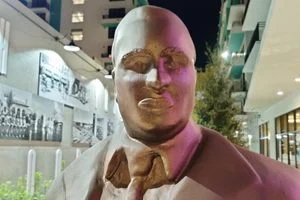
Hollywood’s memorial to its first mayor, Joseph W. Young, stands on a modest promenade just off Hollywood Boulevard. The setting is easy to miss: an apartment building on one side, an optometrist’s storefront nearby, and a few benches and trees around the statue. People moving along the boulevard have plenty competing for their attention, and this memorial doesn’t announce itself with a grand entrance or imposing scale. It’s the kind of public object you might walk past before realizing what it’s meant to represent.
That quiet placement shapes the encounter. A visitor who stops can take in the figure at close range, without the distance that can make a large civic monument feel imposing. But proximity also puts every detail on display. Here, the workmanship becomes the main attraction, and the contrast between the memorial’s purpose and its appearance is hard to ignore.
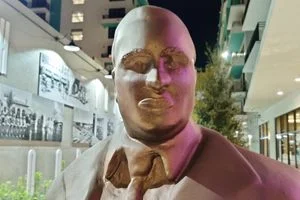
The figure appears to be molded plastic rather than bronze or stone, and its shoes look spray-painted. Its posture leans awkwardly backward; the face has features that some observers might compare to a child’s drawing. Those are impressions, not a record of the materials or the artist’s intent, which aren’t established by the available account. Still, the physical effect is plain: this doesn’t look like the kind of polished, durable monument many people expect when they encounter a civic memorial.
A memorial marked by wear
Wear has become part of the statue’s story. Residents and visitors have noticed visible damage, including burn marks and a missing finger, and a cigarette butt has been left between the figure’s fingers. Those details can turn an ordinary stop into an uncomfortable one. They suggest that the object hasn’t been protected from casual damage or treated with much care by everyone who encounters it.
That’s a striking fate for a memorial, though the condition alone can’t explain how it happened. Weather and time can affect outdoor objects, while neglect or deliberate damage can leave other marks. The account describes both weathering and visible harm, but doesn’t establish when the damage occurred, who caused it, or how often the statue has been maintained. A close look raises questions; it doesn’t answer them.
The location adds another layer. The statue sits among everyday businesses and residential surroundings, rather than in a clearly formal monument setting. That makes it accessible, but it may also make the difference between public art and ordinary street furniture less apparent to passersby. (And this is the part most people overlook.) A public memorial’s condition depends not just on its initial construction, but on whether anyone is responsible for looking after it over time.
Questions about its origins
The statue’s appearance has prompted questions about how it was commissioned. Was an artist involved? The account doesn’t identify an artist, describe a selection process, or explain what materials were chosen. It also doesn’t establish who paid for the memorial or how its funding was approved. Those gaps matter because a statue is more than the object on the pavement: it’s also the result of decisions about what to commemorate, how to present it, and who will care for it.
Observers have also raised suggestions about favoritism or misused money. Those are questions, not confirmed findings. Without information about the commission, the funding, or the people involved, the statue’s unusual appearance can’t establish that money was mishandled or that anyone received preferential treatment. The distinction is important. Skepticism about a public project is reasonable, but a rough-looking monument by itself isn’t evidence of misconduct.
The comparison with downtown renovations sharpens the issue. The city has spent money renovating downtown, while this memorial appears worn and poorly finished to many who see it. That contrast may strike residents as a question of priorities: what receives attention, and what gets left behind? But the available account doesn’t say that renovation funds and the statue’s funding came from the same source, or that one project took resources from the other. What it does show is how visible neglect can prompt people to ask how public spaces are managed.
What the statue tells us about public memory
A memorial’s job isn’t only to look impressive. It gives a physical presence to a person or a piece of local history, and it invites the public to connect a place with that history. Young is identified here as Hollywood’s first mayor, but the account offers little about his life or his role in the city. That leaves the statue to carry much of the meaning on its own—and, in its current condition, it may raise more questions about the memorial than it answers about the man.
This is more significant than it looks. A modest monument can still shape how a neighborhood presents its past, particularly when it sits where residents and visitors encounter it in passing. If the work appears flimsy, damaged, or unexplained, people may wonder whether the subject was honored with care. The object’s condition won’t tell them what happened behind the scenes, but it can influence whether the memorial feels like a meaningful civic marker or an overlooked curiosity.
There’s also a practical tension in outdoor public art. A piece that’s easy to approach can feel welcoming, yet it’s exposed to weather, routine wear, and the behavior of people passing through. Similar public objects typically need some combination of durable materials, maintenance, and clear responsibility for repairs. That general point doesn’t establish what was planned for this statue. It does help explain why questions about the work shouldn’t stop at its appearance on the day someone notices it.
Questions that remain
For now, the statue stands as an unusual stop off Hollywood Boulevard, and its story remains incomplete. The account doesn’t identify its maker, explain its funding, or say whether repairs or additional care are planned. Those details would help separate the artistic choices from the later effects of weather and damage. They’d also give the public a clearer basis for assessing how the memorial was commissioned and maintained.
If you’re working in this space, the lesson is straightforward: public art needs a story people can find, along with visible care once it’s installed. A short explanation of who’s being commemorated and how the work came to be can give a passerby useful context. Maintenance matters just as much. Without it, even a memorial intended to honor a civic figure can become known chiefly for its missing finger, painted shoes, and unanswered questions.
And yet, the statue’s oddness has made it hard to dismiss. It draws attention precisely because it doesn’t meet familiar expectations for a civic monument. A curiosity, certainly. Whether it’s also an effective memorial depends on facts about its purpose, history, and upkeep that remain unclear.

Discussion
Sign in to join the discussion.