France’s protests reflect pressure from falling purchasing power and discrimination, while political leaders recast social grievances as a fight over Islam.
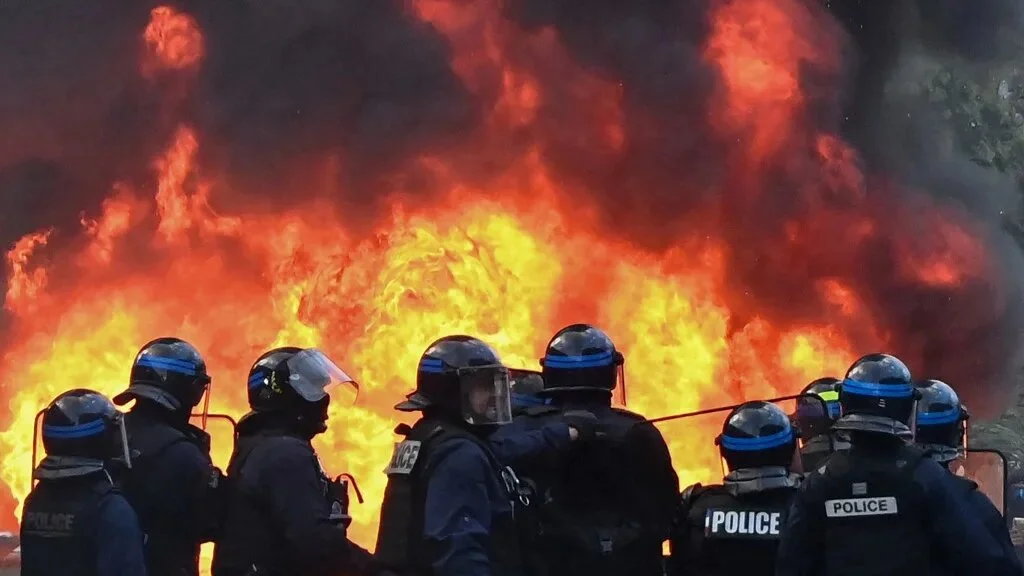
France’s latest protests point to a crisis of political trust that can’t be explained by Islam or immigration. Demonstrations in Paris and other cities this autumn have included violence and property damage, but the grievances at their core are familiar: falling purchasing power, stagnant wages, strained public services and a generation doubtful that its prospects will match those of its parents.
The protests began around students’ demands, including more teachers and better school buildings. Yet the response from prominent politicians has pushed those concerns aside. In the run-up to a French presidential election six months away, competing political campaigns are turning unrest into an argument about national identity. That shift may help parties mobilise supporters, but it leaves the conditions driving people onto the streets largely unanswered.
Discontent with deep roots
President Emmanuel Macron didn’t create France’s problems, but his time in office has coincided with repeated waves of public anger. The Yellow Vest movement, strikes against pension reform, unrest in suburban areas and the demonstrations now taking place all speak to a country that has struggled to regain a sense of stability. The comparison with May 1968, when a student revolt expanded into a national upheaval, reflects the scale of the current moment, though the causes and political circumstances differ.
Economic strain is one part of the picture. Prices have risen, wages have lagged and poverty has spread, placing particular pressure on young people and working and lower-middle-class households. The protests’ reach beyond the capital underscores that these concerns aren’t confined to one city or one community. Critics of Macron’s economic approach argue that it has deepened inequality while weakening public services that people rely on.
Economic pressure sits alongside an enduring contradiction in French civic life. The national ideal promises liberty, equality and fraternity, but many citizens experience discrimination in work, housing and access to services. A person named Mohammed or Aisha may have been born in France, speak French as a first language and come from a family that has lived there for generations, yet still face barriers that make belonging feel conditional.
For many young people of North African or African descent, integration can seem to require cultural conformity without ever guaranteeing acceptance. That gap between formal citizenship and everyday treatment helps explain why anger about schools, jobs and living costs can take on a wider meaning. It’s a dispute over whether the republic’s promise applies equally in practice.
When social demands become an identity story
Students who blockaded schools have raised concrete complaints: absent teachers, deteriorating buildings and a bleak outlook for their futures. US President Donald Trump recast the demonstrations as a religious conflict, writing on Truth Social, “This isn’t about schools, this is about Islam wanting to take over a once great Country!” He offered no evidence for that claim, and the source account says no link had been established between the student movement and religious or identity-based demands. Trump later told reporters outside the White House that “Paris is going to be a Muslim city very soon.”
Israeli Prime Minister Benjamin Netanyahu also framed the unrest as an Islamist threat. Speaking to i24News, he said France had “succumbed to the invasion of extremist Islam” and warned that “they will devour France, they will devour Europe.” He tied the protests to his argument about Hamas, claiming that he had warned Macron after 7 October 2023 that failure to eliminate Hamas in Gaza would bring the group to Paris.
That language echoes Netanyahu’s earlier claims. In 2017, alongside Macron, he said “political Islam seeks to destroy both Israel and European countries.” He has also described Britain as an “Islamic republic.” Across these statements, the political effect is to combine migration, Islam and the conflict over Palestine into one threat narrative, then cast Muslims in Europe as a danger from within.
Here’s the thing: that framing changes the subject. Students asking for teachers and functioning schools become evidence in a story about invasion; expressions of solidarity with Palestinians can be treated as signs of extremism. The result is that Muslim citizens may find themselves viewed with suspicion while the original complaints remain unresolved. The protests described in the source contain no evidence that the students’ movement is directed by Hamas or organised around religious demands.
A campaign shaped by blame
Trump and Netanyahu were speaking to audiences at home: Trump ahead of US midterm elections, Netanyahu during a campaign ahead of Israel’s election. Their comments also enter France’s own campaign season, where the presidential vote is six months away. The themes they invoke—immigration as invasion, Islam as danger and suburban districts as hostile territory—overlap with arguments associated with Marine Le Pen’s far-right politics.
France’s own political leaders have contributed to the contest over blame. Prime Minister Sébastien Lecornu accused ultra-left groups of organising violence and said La France Insoumise (LFI) was fuelling disorder. Le Pen likewise accused LFI of allowing legitimate social demands to be hijacked. The centre and far right thus found common ground in directing attention toward the left, even as the underlying protests raised questions about public services and household finances.
Macron’s record on immigration, Islam and national identity has also made it harder for him to draw a clear line between his government and the right he opposes. Different targets—immigrants, Muslims or left-wing parties—can serve the same political purpose: shifting scrutiny away from decisions made by those in power.
The questions raised by the protests are direct. Why have schools deteriorated? Why has purchasing power fallen? Why do many young people expect to live less comfortably than their parents? Blaming Islam or LFI doesn’t answer any of them.
Domestic strain and a changing role abroad
The unrest also arrives as France’s international influence faces pressure. After formal decolonisation, Paris maintained extensive political, military, monetary and economic ties with former colonies, particularly in Africa. The system known as Françafrique gave France influence beyond what its population and economic weight might otherwise have afforded.
That network is now changing. France has withdrawn forces from Mali, Niger, Chad and the Central African Republic, while relations with Algeria, Senegal and other countries have become more strained. Governments across Africa are expanding ties with China, Russia, Turkey and Gulf states. France’s domestic difficulties and its shifting position abroad are distinct, but together they suggest a country contending with a more limited reach than it once enjoyed.
Macron’s visit to Doha brought the competing pressures into focus. During the October 2026 state visit to Qatar and the wider Gulf, he sought to secure energy supplies amid a cost-of-living crisis at home. The contrast is striking: in 2020, Macron described Islam as being “in crisis across the world,” presenting France as a judge of its condition. Now his government is turning to partners in the Muslim world for help with France’s own economic needs.
That contrast doesn’t settle what France should do next, but it clarifies the question at stake. Recasting protests as a civilisational struggle may give political campaigns a sharper story; it won’t repair schools, restore purchasing power or resolve discrimination. France’s crisis is structural, and the next election will test whether voters see a path through it—or whether the far right’s account of the unrest gains ground.
Discussion
Sign in to join the discussion.