Joe Beeler’s seven-foot sculpture in Muncie depicts a Southern Plains courtship ritual, set in a small riverside park beside the White River.
A courtship scene in a small park
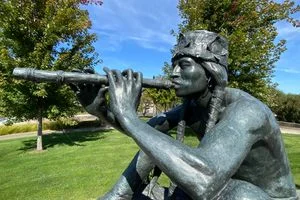
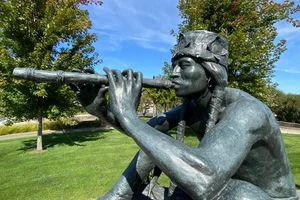
Joe Beeler’s “Night Song” gives a small patch of Riverbend Park in Muncie, Indiana, the intimacy of a private meeting. The roughly seven-foot sculpture depicts a young Southern Plains man playing a flute to invite the woman he loves to meet him after dark. By the scene’s apparent ending, she’s accepted. That simple narrative is what makes the work legible to a passerby: a musician, an invitation, and a response.
Dedicated with the park on December 9, 1998, the sculpture places a distinctly human story in a public setting. The work doesn’t need a long explanation to suggest what’s happening, but its details reward a slower look. The flute gives the young man a way to express interest, while the figures on the base show what follows. A moment of courtship becomes a small sequence, from invitation to companionship.
What the sculpture tells through its details
The rock base carries a bas-relief of animals and the couple walking together, with her arm around his shoulders. Bas-relief keeps the figures attached to the surface rather than presenting them as freestanding forms. Here, that format lets the base function as more than support: it extends the story around the central sculpture. The animals add a natural setting, while the couple’s posture makes the outcome plain without requiring another scene in three dimensions.
The contrast between the figures above and the relief below gives the piece two ways to be read. The standing sculpture catches attention from a distance; the carved detail invites a closer look. It’s a practical choice for a park, where visitors may encounter the work while walking through rather than arriving with time set aside for a gallery visit. The story is immediate, but the base asks for attention.
Beeler, a renowned Western artist and sculptor, described the flute as part of the young man’s courtship. That framing matters. The instrument isn’t simply a prop used to identify the figure; it’s the means by which he makes an invitation. The scene depends on listening as much as looking, even though the sculpture itself is silent.
The flute as an instrument of courtship
The source describes flutes made from aromatic woods, including sumac and juniper, as well as from river cane and sunflower stalks. Those materials point to a broader practical fact about many traditional instruments: their construction can draw on plants available in the maker’s surroundings. The materials also shape how an object feels and sounds, although the sculpture doesn’t specify the design or sound of the flute it depicts.
In the account given here, the flute’s role is social as well as musical. If a woman accepted the song’s invitation, she would join the player; in some traditions, the flute was then destroyed to mark the courtship’s completion. That detail gives the instrument a temporary quality. It serves a particular purpose in a relationship, then may be put away in a strikingly final way.
That practice shouldn’t be treated as a universal rule. The description refers to some traditions, and customs can differ across communities and circumstances. The sculpture offers one carefully framed story, not a complete account of Southern Plains courtship. (And this is the part most people overlook.) Public art can make cultural history approachable, but a single image can’t stand in for the range of practices and meanings behind it.
A quiet story in a busy setting
Riverbend Park is a compact green space with a view of the White River, though traffic rushes past nearby. Visitors can park in the bank lot on the east side; evergreen trees screen the park from the bank. The setting contains an everyday tension: the sculpture presents a private, after-dark encounter, while the park is open to public view and sits within earshot of traffic.
That contrast doesn’t undermine the work. It may sharpen the impression that the scene belongs to a different pace than the road beside it. The trees provide some visual screening, and the river gives the park an open outlook, but the location remains part of a working city. A visitor encounters the artwork amid ordinary movement and noise, not in an enclosed exhibit where every detail is arranged for quiet attention.
If you’re visiting, the compact scale makes “Night Song” the kind of work you can take in quickly, then revisit for its smaller details. Look first at the flute and the figures, then around the base at the animals and the couple walking together. The sculpture’s story is straightforward; the relief gives it a second beat.
Why the small scale matters
Public sculptures often have to communicate across different kinds of attention. Some people stop and study them; others see them in passing. A work built around a recognizable gesture can reach both groups, while details in its base offer something for visitors who stay. “Night Song” uses that structure to tell a story that’s personal in subject but accessible in form.
This is more significant than it looks. The sculpture doesn’t rely on spectacle to claim space in the park. Instead, it gives a familiar public place a narrative tied to music, courtship, and the natural world. The result depends on the viewer understanding the relationship between the flute player and the woman, then noticing how the relief confirms the apparent outcome.
There are limits to what the work can explain on its own. A sculpture can represent a tradition, but it can’t supply all the context needed to understand the people and customs behind that representation. Beeler’s description helps frame the flute’s purpose, and the account of its materials and use adds texture to the scene. The rest is left to the viewer: a brief encounter with a story that continues beyond the stone.
And yet, the park’s everyday setting is part of the point. “Night Song” makes room for a quiet courtship story beside a river and near passing traffic. For visitors, that’s a modest but memorable shift in attention: a small green space becomes, for a few minutes, a place where music is an invitation and an answer changes what happens next.

Discussion
Sign in to join the discussion.