Dedicated in 2021, the Willowbrook memorial remembers the 78 people killed when TWA Flight 529 crashed in 1961 and those who responded.
A memorial keeps the flight in view
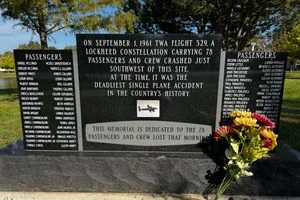
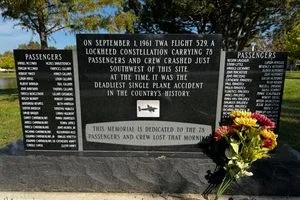
A black granite memorial in Willowbrook, Illinois, keeps the story of TWA Flight 529 in public view. Dedicated on September 1, 2021, the 60th anniversary of the crash, it bears the names of the victims and an account of the flight. Its reverse honors the first responders and volunteer fire departments who handled the aftermath. The two sides hold related parts of the same history: the lives lost and the people who came to help.
That distinction matters. A memorial to an aviation disaster can preserve more than the basic record of where and when a plane went down. It can also mark the effect on a community that encountered the wreckage and its aftermath, even when the crash occurred outside a city center or airport. Here, the stone gives local residents a fixed place to remember an event that might otherwise have become a line in an old news account.
The memorial’s wording also gives visitors a concise account to encounter in person. A name on a marker is a simple form of recognition, but it makes the scale of a loss harder to treat as an abstraction. Entire families were among those killed on Flight 529. The names represent individual lives, while the shared date and location tie them to one event.
The flight and the crash
The Lockheed Constellation L-049 left Chicago’s Midway Airport at 2 a.m. on September 1, 1961, bound for Las Vegas and then Los Angeles. The flight had begun in Boston, with stops in New York, Pittsburgh and Chicago. Its route linked several cities before the final westbound leg, and the aircraft was only minutes into that leg when it crashed.
Five minutes after takeoff, the aircraft pitched up, stalled and came down in a cornfield in what is now Willowbrook. First responders arrived within minutes, but all 73 passengers and five crew members died. No homes were struck. The crash site’s rural setting meant the plane came down in a field rather than in a residential area, though that fact did nothing to reduce the human cost for the people aboard or for those who reached the scene.
In aviation, a stall describes a loss of lift that can occur when a wing’s angle to the oncoming airflow becomes too great. It’s a technical term, but the sequence described here is stark: the aircraft pitched upward, stalled and crashed. The cause identified by investigators was a 5/16 mm bolt in the elevator boost that had fallen out before takeoff. The elevator is part of the aircraft’s control system; the source identifies the missing bolt as the failure tied to the accident.
That mechanical detail shows why small components can carry large consequences in complex machines. An aircraft’s controls depend on connected parts working together as intended. A component may be physically modest, yet its role in a control system can be significant. The account doesn’t provide further engineering findings, so it can’t establish how the bolt came loose or what inspections were performed. It does, however, identify the failed part and the chain of events that followed.
What the cause tells us
Investigations into transportation accidents often have to translate a physical failure into a clear explanation of how a tragedy unfolded. That work matters for public understanding, but a concise cause can leave unanswered questions. In this case, the reported finding connects a missing bolt in the elevator boost to the aircraft’s loss of control. It doesn’t, by itself, tell readers what happened before the bolt fell out or how the failure was detected—or missed.
That limit is worth keeping in view. A single mechanical cause can make an accident seem simple after the fact, even when the surrounding questions are complex. The source gives no basis for assigning blame or describing changes to aircraft procedures, and those claims shouldn’t be filled in from assumption. What it does establish is enough to make the basic lesson plain: safe flight depends on the condition and function of components that passengers rarely see.
Similar systems typically rely on inspection and maintenance to catch wear, damage or missing parts before operation. That general point helps explain why the bolt matters, but it doesn’t answer what specific safeguards applied to Flight 529. The distinction between general context and documented fact is especially important in accounts of old disasters, where readers may be tempted to supply missing details with modern expectations.
A loss that outlasted the headlines
At the time, the crash was the deadliest plane disaster. The passage of time can change how an event is remembered: immediate public attention fades, witnesses and family members age, and later generations may know little about what happened nearby. Here's the thing: a local memorial can counter that drift without pretending to recreate the event. It gives the community a place to return to the names, the date and the circumstances.
This is more significant than it looks. The memorial’s attention to first responders and volunteer fire departments records the work that began after the crash, while its list of victims preserves the scale of the loss. Those roles belong in the same account. Emergency responders weren’t the central victims of the disaster, but they were part of the community’s experience of it, and the memorial acknowledges that contribution.
(And this is the part most people overlook.) The memorial is also a public source of context for people who weren’t alive when the crash occurred. A visitor doesn’t need to know the history of commercial aviation to understand the core facts: a scheduled flight left Midway, crashed minutes later, and killed everyone aboard. A local marker makes that history accessible at the place where its consequences were felt.
If you're working in this space—whether in aviation, local history or emergency response—the story offers a reminder that the public record depends on more than technical findings. It also depends on communities preserving names and describing the human response. The marker can’t answer every question about the accident. But it can keep the known facts visible, and give visitors a reason to ask what happened.
Why the marker still matters
Local residents organized to establish a permanent tribute as memories faded. That effort turned remembrance into something durable: a physical object in Willowbrook that identifies the victims and recognizes the responders. The memorial doesn’t erase the distance between the event and later generations. It gives that distance a point of reference.
And yet, a marker’s value depends on people encountering it and taking time to read it. The granite alone can’t preserve a story if the story isn’t shared. Its account of the flight, the victims and the emergency response gives the community a concise record to carry forward. A catastrophe might otherwise recede from view. Here, it has a name, a location and a place to be remembered.


Discussion
Sign in to join the discussion.