Morro Castle’s 9 p.m. cannon ceremony draws crowds, while daytime tours reveal its lighthouse, prison history and sweeping views of Havana.
Two ways to experience the fortress
Morro Castle offers two distinct ways to take in its history, and the difference is more than a matter of timing. At 9 p.m. each night, reenactors dressed as 18th-century Spanish colonial soldiers perform a cannon-lighting ceremony. The report carries across much of Old Havana, while visitors watching from the castle grounds can stand closer to the spectacle. By day, the same site becomes a place to examine its lighthouse, fortress and former prison rooms at a slower pace.
That contrast gives a visit a useful shape. The evening ceremony presents the fort as a public performance, with uniforms, sound and a carefully staged action connecting the site to its colonial past. Daytime visits offer more room to notice the buildings and the scale of the grounds. Neither experience tells the whole story on its own; together, they let visitors move between the fortress as a historic structure and as a place that still draws people to gather.
The ceremony and the sound of the cannon
The nightly cannon-lighting ceremony is the clearest focal point for an evening visit. Its appeal rests partly on the setting: a performance takes place at a fortress whose defensive purpose is visible in its walls, ramparts and cannons. The report carries across much of Old Havana, so the event isn’t confined to the people gathered inside the grounds. Sound makes the ceremony part of the wider city’s evening atmosphere.
Watching from the castle grounds brings visitors closer to the action, but proximity changes the experience rather than simply improving it. From nearby, the reenactors and the steps of the ceremony take center stage. From farther away, the sound travels beyond the fort and gives the event a broader reach. That’s a small but telling feature of the site: the fortress can be experienced as a destination, while its ceremony also registers across the surrounding neighborhood.
The reenactment has an obvious theatrical element. Visitors are seeing a modern performance, not stepping into the past, and that distinction matters when considering what the ceremony can explain. Still, a staged event can make an abstract idea more immediate. The sound and setting help people picture why a fortified coastal position might have mattered, even if a single ceremony can’t convey the full history of the place.
Exploring the lighthouse and grounds by day
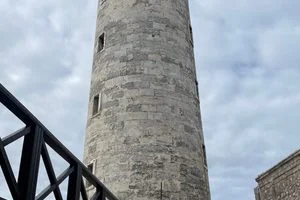
Daytime tours cover the lighthouse, the fortress and rooms once used as a prison. That range gives the visit several points of interest: visitors can look at the fort’s structure, climb for a view, and see spaces associated with its past uses. The rooms and ramparts offer different kinds of evidence. One invites attention to how the site was built and used; the other opens a view over Havana and the ocean.
Climbing the lighthouse is a practical highlight, especially for visitors who want to understand the site’s position in relation to the city and the coast. From above, broad views over Havana and the ocean make the fort’s setting easier to read. The view doesn’t replace the details of the buildings, though. It gives them context: the lighthouse, walls and surrounding landscape occupy the same frame, making the site’s coastal location hard to ignore.
The grounds are extensive, and visitors can explore them at their own pace. That freedom can make a visit feel less like a checklist and more like an opportunity to notice details along the way. It also calls for a little practical planning. Sturdy walking shoes are recommended because the size of the site means time on foot is part of the experience, rather than a brief transition between exhibits.
Reading the fort from its ramparts
From the ramparts, the cannons and the distant horizon make the fortress’s defensive role easy to picture. This is more significant than it looks: the setting connects the fort’s physical features to the purpose they served. A cannon seen on a rampart is more legible than one encountered as an isolated object, because the view outward suggests what the fort was positioned to watch and defend. The horizon becomes part of the interpretation.
That kind of connection is one reason historic fortifications can be compelling to visit in person. A description can explain that a structure was defensive, but walking its grounds helps a visitor grasp its scale and vantage points. At Morro Castle, the ramparts offer a direct way to relate the cannons to the surrounding coast and city. The experience remains an impression rather than a complete account of the fort’s history, but it gives visitors a concrete starting point.
And yet, the site’s scale can also shape what visitors take away. A quick visit may focus on the ceremony or the view, while a longer one leaves more room to explore the grounds and the rooms included in the tours. There’s no need to treat every feature as equally important; the value lies partly in choosing what deserves attention. If you’re working out how to spend your time here, decide whether the evening performance, the daytime tour or the climb matters most to you.
What the two experiences add up to
Morro Castle’s strongest visitor proposition is the way its attractions complement one another. The nighttime ceremony gives the fortress a public, audible presence, while the daytime visit gives its architecture and grounds more room to speak. A person who attends both can compare a staged connection to history with the physical evidence of the site itself. That difference is useful. It keeps the visit from being only a performance or only a walk through old rooms.
There are limits to what a visitor can learn from either experience. A cannon-lighting ceremony can make the fort’s martial identity vivid, but it can’t stand in for a full historical account. A panoramic view can clarify the site’s position, but a view alone doesn’t explain everything that happened within the walls. The best approach is to treat the ceremony, lighthouse, former prison rooms and ramparts as pieces of a larger place, each offering a different kind of context.
Here’s the thing: the fort’s scale is both an attraction and a demand on the visitor. Its extensive grounds reward unhurried exploration, but walking them takes effort, which is why sturdy shoes matter. The lighthouse climb adds another physical element, while the evening ceremony offers a more concentrated experience. (And this is the part most people overlook: the sound of the event reaches beyond the people who’ve come to watch.) A striking view. A loud reminder of the fort’s setting.
For visitors, the choice isn’t simply whether to see a historic site. It’s whether to encounter Morro Castle through its evening ritual, its daytime spaces, or both. The ceremony offers atmosphere and a clear focal point; the tour provides a closer look at the lighthouse, fortress and former prison rooms. Taken together, they make the castle easier to picture as both a destination and a working piece of Havana’s visual and acoustic setting.


Discussion
Sign in to join the discussion.