George Costello fought for the Union, returned to Ireland after the war and later settled in Stockport, where his grave records his life and family.
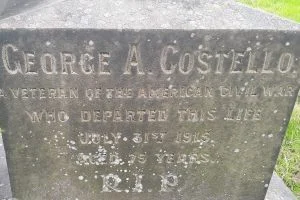
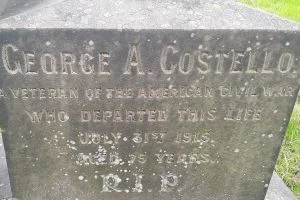
George A. Costello’s grave in Stockport connects the American Civil War to Irish migration and a later generation’s role in the 1916 Easter Rising. The sandstone marker stands in a Catholic section of a municipal cemetery in Greater Manchester, among graves bearing many Irish names. Its once three-foot cross has been damaged and now rests leaning against the stone. That physical damage changes how the memorial reads: the cross is still present, but its separation from the upright stone makes the grave feel less like a finished monument than an object whose history is slowly becoming harder to read.
The inscription identifies Costello as a veteran of the American Civil War and records his death on July 31, 1915, aged 75. Lower down, the marker names his wife, Mary, who died in 1919, and Emily Rose Parr, who died in 1924. The partly obscured inscription also mentions Norah Parr. Those names place several generations on one small surface, though the worn lettering leaves gaps in what the stone can tell us. A cemetery inscription is a compressed record: it preserves relationships and dates, but it rarely explains how a family moved between countries or what its members believed.
From Union infantry to the reserve corps
Costello enlisted in Company I of the 42nd New York Infantry as a paid substitute for a conscripted man. He later served in Company C of the 82nd Regiment and Company D of the 59th Regiment, reaching the rank of corporal. His service across multiple units gives the outline of a military career, but the surviving details here don’t establish how or when each transfer occurred. The substitute arrangement also gives a glimpse of the ways people entered the Union army: Costello served in place of another man who had been conscripted, making military service part of a broader system of obligation and payment.
At the Battle of Spotsylvania Court House, he was wounded in the hand by a Minié ball. The roughly two-week battle ended in a Union victory under Ulysses S. Grant, with about 18,000 Union casualties, killed and wounded. The scale of the fighting helps explain why a hand wound could alter the course of Costello’s life, even if it didn’t end his service altogether. For an infantryman, the ability to handle equipment and weapons was central to the job; an injury that limited that work could make a return to frontline duty impractical. The source doesn’t describe the severity of Costello’s wound in detail, so the precise effect on his daily abilities remains unclear.
The injury left Costello unable to continue as a frontline infantryman, so he transferred to the Veteran Reserve Corps, first known as the Invalid Corps. The change of assignment reflects a distinction between leaving military service and leaving the front line: the reserve corps offered a way for injured soldiers to remain in service in a different capacity. Here’s the thing: the transfer helps explain how Costello’s military record could continue after a serious wound, but it doesn’t tell us what his duties were or how he experienced that transition. A service record can establish movement between units without capturing the physical limits, routine, or personal cost behind it.
A family story places Costello on Abraham Lincoln’s guard detail at Ford’s Theatre on the night Lincoln was assassinated by John Wilkes Booth. The account is considered unlikely, and the available details don’t establish that he was there. That uncertainty matters. Stories linked to a famous event can become attached to a family history precisely because they make a life easier to remember, but repetition isn’t the same as proof. In Costello’s case, the account should remain a family story rather than a confirmed episode in his service.
From Dublin to Stockport
After the war, Costello returned to Dublin and tried to resume work as a coach maker. His wounded hand made the trade difficult; he eventually received a U.S. veterans’ pension. The account connects an injury sustained in American military service with the practical challenge of returning to skilled work in Ireland. It also shows how the war continued to shape his life after the fighting ended: the pension became part of the story because his ability to earn a living had been affected. The available details don’t specify when the pension began or how much support it provided.
Around 1891, he and his family moved to Stockport. That move placed a former Union soldier in a town in Greater Manchester, within a wider history of Irish migration to Britain. The grave’s location in a Catholic section, among many Irish names, gives the family’s later home a local setting. But a cemetery marker can’t explain the reasons for the move, the work the family found, or the community ties they formed after arriving. Those details aren’t supplied here, and the gap is a useful reminder that migration is visible in records and places even when the personal decisions behind it are not.
For Costello, the journey from Dublin to Stockport followed an earlier crossing into American military life and back again. His biography resists a tidy national label. He served in Union units, returned to Ireland, then settled in England; the grave holds these strands together without resolving them into one simple story. And this is the part most people overlook: the marker’s importance comes not only from its connection to a major war, but also from the way one family’s movements linked places whose histories are often discussed separately.
A family history carried forward
By the time Costello died, his grandson Liam Parr was active in the Irish Republican movement and arranging arms shipments to Irish rebels from England. Parr later took part in the Easter Rising of 1916. The sequence places Costello’s death in 1915 just before his grandson’s participation in a landmark episode of Irish republican history. It doesn’t, by itself, show that Costello shaped Parr’s politics or knew about the arms shipments. The connection is biographical and familial, not proof of direct influence.
Still, the family link gives the grave a reach beyond Costello’s own military service. One generation’s history includes the American Civil War and an injury that affected a trade; another generation appears in the movement for Irish independence. If you’re working in this space, the distinction between documented connections and inferred influence is especially useful: family relationships can show how histories meet, while leaving open what passed between relatives in conversation or belief. A record can connect two lives without supplying the missing chapter.
The grave’s inscriptions preserve the family’s history in Stockport, while its connection to Costello’s wartime service reaches across the Atlantic. Its damaged cross and partly obscured names also show the limits of memorials as historical sources: they can anchor a story, but they can’t tell it all. This is more significant than it looks. A single grave gathers migration, military service, injury, and later political action into one place, even as the details require careful separation between what the record states and what it leaves unknown.


Discussion
Sign in to join the discussion.