A concrete replica of Perstorp’s familiar vinegar bottle celebrates the town’s acetic acid history and points visitors to local attractions.
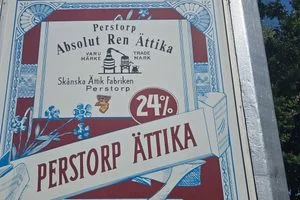
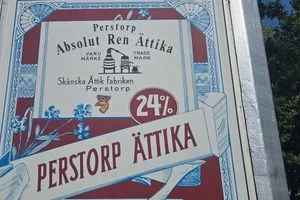
A five-meter concrete bottle turns Perstorp’s best-known kitchen staple into a roadside landmark. Its red cap and label echo the familiar glass vinegar bottle recognized by many Swedes. The scale changes the object’s role: a container made for a kitchen shelf becomes a public marker, large enough to catch the attention of people entering town. It’s a simple idea, but one with a clear local purpose. The bottle makes an everyday product stand in for a much longer story about manufacturing and place.
A landmark rooted in local production
Perstorp’s factory began making acetic acid in 1881, using materials from the surrounding beech forests. The replica stands beside a main road into the town center, tying that industrial history to the product still found in Swedish kitchens. That connection gives the sculpture more substance than a giant product logo: it points to production that began locally and became part of ordinary domestic life. The details in the source don’t explain how the original process worked, but they do make clear that the area’s natural resources were part of the factory’s early story.
There’s a useful distinction here between celebrating a product and marking an industrial past. A bottle is instantly legible; most passersby don’t need an explanation to understand what it represents. The factory history adds another layer, linking the familiar vinegar in the glass bottle to acetic acid made in Perstorp over a long span of time. This is more significant than it looks. The sculpture takes a routine household item and gives it a civic role, making local industry visible in a form that residents and visitors can recognize at a glance.
From kitchen object to public spectacle
Unveiled in 1994, the bottle’s opening drew music and a speech from television chef Jan Boris-Möller. He demonstrated how vinegar can soften an eggshell enough to squeeze an egg into a bottle. The demonstration connected the landmark to the substance it represents: vinegar wasn’t merely named in a speech, but shown doing something that could surprise an audience. A public opening can give a place a shared story, and this one had an unusually apt prop at its center.
The egg demonstration also points to a broader feature of familiar materials. People may know vinegar as a cooking ingredient without thinking much about its other uses or properties. A small, visible experiment can make that knowledge memorable. It gives the audience a reason to look at the bottle as more than an oversized sign, even if the source doesn’t say how many people attended or how the event was received. The detail is specific enough to convey the spirit of the unveiling without requiring a grand claim about its impact.
And yet, the landmark’s meaning doesn’t depend on the opening ceremony alone. A public sculpture has to work after the speeches and music have ended. Its roadside position keeps the bottle in view, while its recognizable colors and shape do much of the explanatory work. That’s a practical form of local storytelling: the object signals a connection to Perstorp before a visitor has read a word about the town’s history.
A small guide built into the landmark
Laminated panels on the structure offer a cucumber-pickling tip and list places to visit in the municipality, all in Swedish. The landmark makes Perstorp’s vinegar heritage visible while doubling as a small guide to the town. Those panels bring the sculpture back to the everyday scale of its subject. Vinegar is associated with preserving food, and the pickling tip gives that association a direct, practical expression; the visitor information, meanwhile, turns the bottle into a place to pause and look for more.
The Swedish-only text also sets a limit on who can readily use the panels. A visitor who reads Swedish can take in the local suggestions directly, while others may still understand the bottle’s broad reference from its familiar design. That difference is part of how public landmarks work: the visual image can travel farther than the explanation written beside it. (And this is the part most people overlook.) A landmark can welcome people through recognition while still asking them to know the local language to get the full account.
For a town associated with a particular product, that combination of visual symbol and practical information can make a roadside structure do several jobs at once. It identifies a place, recalls a production history and gives visitors a prompt to explore. It doesn’t need to be a full museum or a detailed industrial archive to be useful. A sign, a recognizable form and a concise local reference can make a brief encounter more informative.
What the bottle says about place and identity
Many towns use visible markers to connect a local identity with the work or products associated with the area. The approach can be modest: a landmark makes the connection tangible, while nearby text supplies context. Perstorp’s bottle follows that pattern through a concrete replica, the factory history and the pickling advice. Its strength is clarity. Its limitation is also clear: a single product can represent only part of a town’s history, and the panels described here offer a small selection of information rather than a complete account.
If you’re working in this space, the useful lesson is that scale alone doesn’t create a meaningful landmark. The connection has to be easy to read. Here, the bottle resembles a product many Swedes recognize, stands by a route into the town center and sits within a story that reaches back to local production. Each element reinforces the others. Without those links, a very large replica might be little more than a roadside curiosity.
Implications for the visitor experience
The bottle’s future value rests on the same qualities that make it legible now: its distinct shape, its connection to Perstorp and the information attached to it. As a roadside landmark, it can introduce the town to people passing through; as a small guide, it can direct attention toward places to visit. The source doesn’t establish how many people stop or what effect the sculpture has on local tourism, so those results shouldn’t be assumed. The case for the landmark is simpler: it gives a recognizable form to an industrial heritage that might otherwise remain abstract.
That said, the object invites a question about what a town chooses to preserve in public view. Perstorp’s vinegar story links a factory, a forest-based origin described in the source and a product associated with Swedish kitchens. The concrete bottle holds those pieces together in one image. Not a complete history, but a memorable starting point.
For visitors, the sculpture offers an easy entry into the subject. For residents, it gives a familiar product a place in the town’s public identity. And for anyone passing the road, it makes an ordinary bottle difficult to overlook.

Discussion
Sign in to join the discussion.