Tehran urged citizens to avoid non-essential travel to France, Belgium and Italy as French protests escalated and officials traded accusations over police conduct.
A travel warning becomes part of a wider dispute
Iran’s travel warning for France, Belgium and Italy lands amid a widening dispute over how governments treat protesters. Tehran cited intensifying unrest and disruptions to public order, while French authorities faced scrutiny over injuries to demonstrators and restrictions on protests. The advisory is practical in form: it tells Iranian citizens where to avoid and when to limit travel. Its political effect is harder to separate from the argument between Tehran and Paris over whose account of protest rights should be believed.

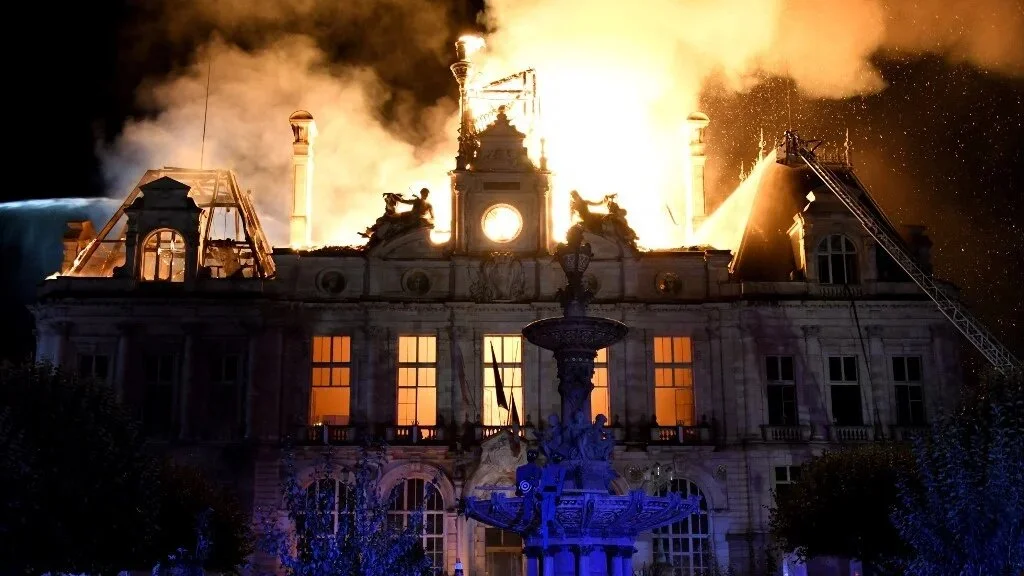
A fire burns and destroys the city hall in the French city of Limoges on 17 October after a group forced entry into the building during ongoing protests (AFP/Pascal Lachenaud).
Tehran issues travel warning as unrest grows
Iran’s foreign ministry issued its advisory on Monday, telling citizens already in France, Belgium and Italy to stay away from tense areas and conflict zones and avoid unnecessary travel, particularly where conditions are unstable. It said the warning followed an “intensification of unrest and disruption of public order.” The guidance describes a broad risk rather than identifying particular streets, incidents or travel routes, leaving citizens to judge local conditions as they change.
France has seen increasingly violent demonstrations, with economic hardship compounded by the Israeli-US war on Iran. At least two people have died during the protests, and police have arrested at least 2,000. Among the reported injuries, two protesters lost their hands after stun grenades detonated. Those figures give the unrest a human cost beyond the familiar images of clashes and fires, while the reported use of force has become a central point of contention between protesters, officials and rights groups.
French authorities have barred protests in some cities. The government has also declined to rule out declaring a state of emergency, a step that would broaden police powers to search and arrest people. Such restrictions can be presented as a response to immediate disorder, but they also shape whether people can gather publicly and how much discretion police have when demonstrations turn volatile. That tension is at the heart of the criticism directed at the French government.
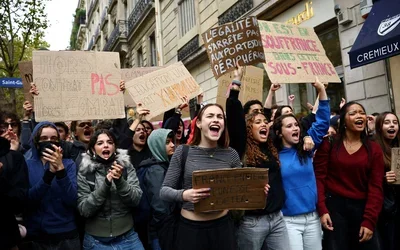
Amnesty International has accused French police of using unnecessary and disproportionate force against demonstrations led mainly by students. Anne Savinel-Barras, president of Amnesty International France, said young people peacefully demanding education “must be protected rather than being beaten, tear-gassed, or arbitrarily detained.” Her statement draws a distinction between the right to protest and violence at demonstrations; the available account does not establish that every protest was peaceful, or that every police action followed the same pattern.
Reuters reported that police in the Paris suburbs fired a tear-gas projectile into the face of a 14-year-old boy, Eden, breaking his jaw and smashing his teeth. A reported injury like this makes scrutiny of police tactics concrete, rather than a dispute over competing descriptions of “order” and “violence.” It also raises questions about the risks of crowd-control weapons when police use them in densely populated settings.
Iran and France trade accusations
The advisory also sharpens a public clash between Tehran and Paris. Iranian Foreign Minister Abbas Araghchi accused French President Emmanuel Macron on X of siding with US President Donald Trump in the war on Iran. The accusation links France’s position on the conflict to its handling of domestic demonstrations, making the argument broader than a disagreement over travel safety.
“Macron made his bed when he assured POTUS that he welcomes atrocities against Iranians,” Araghchi wrote on Monday. He argued that France’s role in the conflict left Macron poorly placed to criticize the unrest, and urged him to hear French protesters’ demands for “wholesale change, including freedom of assembly.” The charge is pointed, but it comes from a government whose own record on protest is part of the dispute. That context matters when weighing Tehran’s criticism of Paris.
Iranian officials have also challenged what they describe as a French double standard. On 6 October, foreign ministry spokesman Esmaeil Baghaei recalled France’s January 2026 calls for peaceful assembly in Iran and government restraint toward protesters. He contrasted that language with French officials’ response to student demonstrations, which he said were being described as “urban violence.” His comparison focuses on the language governments use: whether demonstrations are treated as demands for rights or as a threat to public order.
Baghaei pointed to calls by France’s interior minister for swift intervention and force to restore order, asking why similar conduct was judged differently depending on whether protesters were in Iran or France. The question has political force because governments often invoke public order when confronting mass demonstrations. But comparing official statements doesn’t, by itself, establish that the situations or the state responses are equivalent.
The comparison carries a stark record of its own. Thousands were reported killed in an Iranian crackdown after mass protests in January, when security forces opened fire on crowds and arrested thousands. Amnesty International said the scale of killings and repression since 8 January was unprecedented, even by the Iranian authorities’ record. That record complicates Tehran’s attempt to present itself as a neutral judge of French conduct, even as allegations of excessive force in France warrant scrutiny on their own terms.
Paris has rejected Tehran’s framing. On 7 October, French Foreign Minister Jean-Noel Barrot summoned Iran’s ambassador, citing what France called an Iranian “disinformation campaign” about the high school student movement. Tehran’s warning now adds a travel advisory to a dispute already centered on protest rights and the credibility of both governments’ claims. Here's the thing: a government can issue useful safety guidance and pursue a political argument at the same time.
What the dispute means for protesters
The immediate stakes are different for the people involved. Iranian citizens in the three European countries have been told to avoid volatile areas, while French students and other demonstrators face restrictions, arrests and reported injuries. For readers trying to assess events, the distinction between verified incidents, official claims and political accusations matters; each tells a different part of the story.
This is more significant than it looks: competing claims about protest rights can shift attention away from what demonstrators are demanding and toward which government has the standing to speak. The numbers here are underwhelming as a full account of the unrest; they establish a toll and the scale of arrests, but they don’t explain how widely protests have spread or how each incident unfolded. If you're working in this space, the useful test is to follow the evidence about specific restrictions and injuries alongside each government’s rhetoric.
And yet. A travel warning may help people make cautious decisions, while also serving as another public message in a diplomatic dispute. For protesters, the more consequential questions remain whether they can assemble, how police respond, and whether authorities investigate reported abuses. The answers will matter more than the wording of either government’s accusations (and this is the part most people overlook).
For citizens deciding whether to travel: check local conditions. That’s the practical point.


Discussion
Sign in to join the discussion.