Azerbaijan’s school hijab ban has barred students and teachers, reviving debate over state control of Muslim women’s religious practice.
A school dress code revives an old argument over state power
The significance of Azerbaijan’s hijab ban reaches well beyond what students wear to class. It revives a familiar claim: that the state can decide when Muslim women’s religious practice counts as emancipation and when it must be suppressed. A century ago, Soviet authorities pursued that claim through campaigns against the veil. Today, girls and teachers are being barred from schools for covering their hair.
In recent weeks, pupils have clung to teachers facing dismissal, and girls who refused to remove their headscarves have been turned away. Other students have protested alongside them; parents have demanded that their daughters be allowed to study without abandoning their convictions. Reports from Azerbaijan’s schools describe scenes of distress and defiance. The case of Gulshan Aliyeva, an English teacher with 23 years’ experience, makes the policy personal: she was refused entry to her Baku school, and so was her daughter. Their offence was wearing the hijab in a country where the overwhelming majority identify as Muslim.
That conflict sits inside a political system accustomed to directing public life. For more than three decades, Azerbaijan has been ruled by one family. Ilham Aliyev succeeded his father as president in 2003, following an election widely criticised for serious irregularities. The country opened itself to capitalism, oil wealth and foreign investment, while political authority remained centralised and independent organising faced hostility. Opposition parties have been severely restricted; journalists and activists have been imprisoned. Economic opportunity, too, is closely tied to political connections.
Power concentrated in one family
In 2017, Aliyev made his wife, Mehriban Aliyeva, first vice president, placing her first in the constitutional line of succession. She is part of the influential Pashayev family, whose business interests include banking, insurance and construction. With the president in the country’s highest office and his wife in the second, relatives also holding stakes in major businesses, allegations of conflicts of interest and economic capture have persisted.
Here’s the thing: the same establishment that commands political and economic life now asserts authority over whether a girl or her teacher may enter a classroom in a headscarf. A dynasty with influence over the country’s institutions and wealth is confronting schoolgirls who refuse to uncover their hair.
But the traditions under dispute predate the modern Azerbaijani state by centuries. The Juma Mosque of Shamakhi dates to the eighth century and ranks among the Caucasus’s oldest mosques. Ganja produced the Persian poet Nizami, while Shirvan was home to Khaqani. In the historic Azerbaijan now within Iran, Bahmanyar became a leading pupil of Avicenna, and Nasir al-Din al-Tusi established the Maragheh Observatory in the thirteenth century, then one of the most advanced astronomical centres of its time. Across Shirvan, Arran and surrounding regions, mosques, madrasas and scholarly circles carried religious learning, philosophy, poetry and science across generations.
By the early 1900s, Baku had become a centre of Muslim reform. Oil money supported newspapers, theatres, schools and charities, while intellectuals argued for education, social change and broader opportunities for women. In 1901, philanthropist Haji Zeynalabdin Taghiyev opened a school for Muslim girls, among the first in the Muslim territories of the Russian Empire.
This history complicates any claim that progress had to arrive from outside. Muslim society in Azerbaijan was already debating modernity on its own terms. The republic founded in 1918 established parliamentary institutions and granted women the vote while several European countries still denied it. The experiment lasted less than two years: the Red Army invaded in April 1920.
Soviet rule and the remaking of religious life
The Bolsheviks saw religion as an obstacle to socialism. The Communist Party sought to replace belief with official atheism and to dismantle institutions that could hold authority beyond its reach. Mosques were closed or demolished; others became cinemas, clubs or warehouses. Religious schools were dismantled, religious endowments confiscated and Islamic courts abolished.
Schools carried atheist propaganda, while the League of the Militant Godless campaigned against religious belief and practice. Of about 1,369 mosques operating in Azerbaijan in 1928, just 17 were still open in 1933. Baku’s Juma Mosque was converted into a carpet museum; the historic Bibi-Heybat Mosque was demolished in 1936. Stalin’s purges also struck the religious leadership, with clerics and scholars arrested, exiled or executed.
The state’s reach extended into written memory. Azerbaijani shifted from Arabic to Latin script in 1929, then to Cyrillic a decade later. These changes formed part of broader Soviet language and nationality policies, with aims beyond suppressing religion. Their effect was still profound: within a generation, many people could no longer read the religious scholarship, poetry and family records familiar to their grandparents.
Religious education was suppressed, and the few remaining mosques could not teach children freely. For party members, teachers and other public employees, visible religious observance could damage a career and reputation, or cost them their freedom. The lesson was plain: safety and advancement depended on conformity to state ideology.
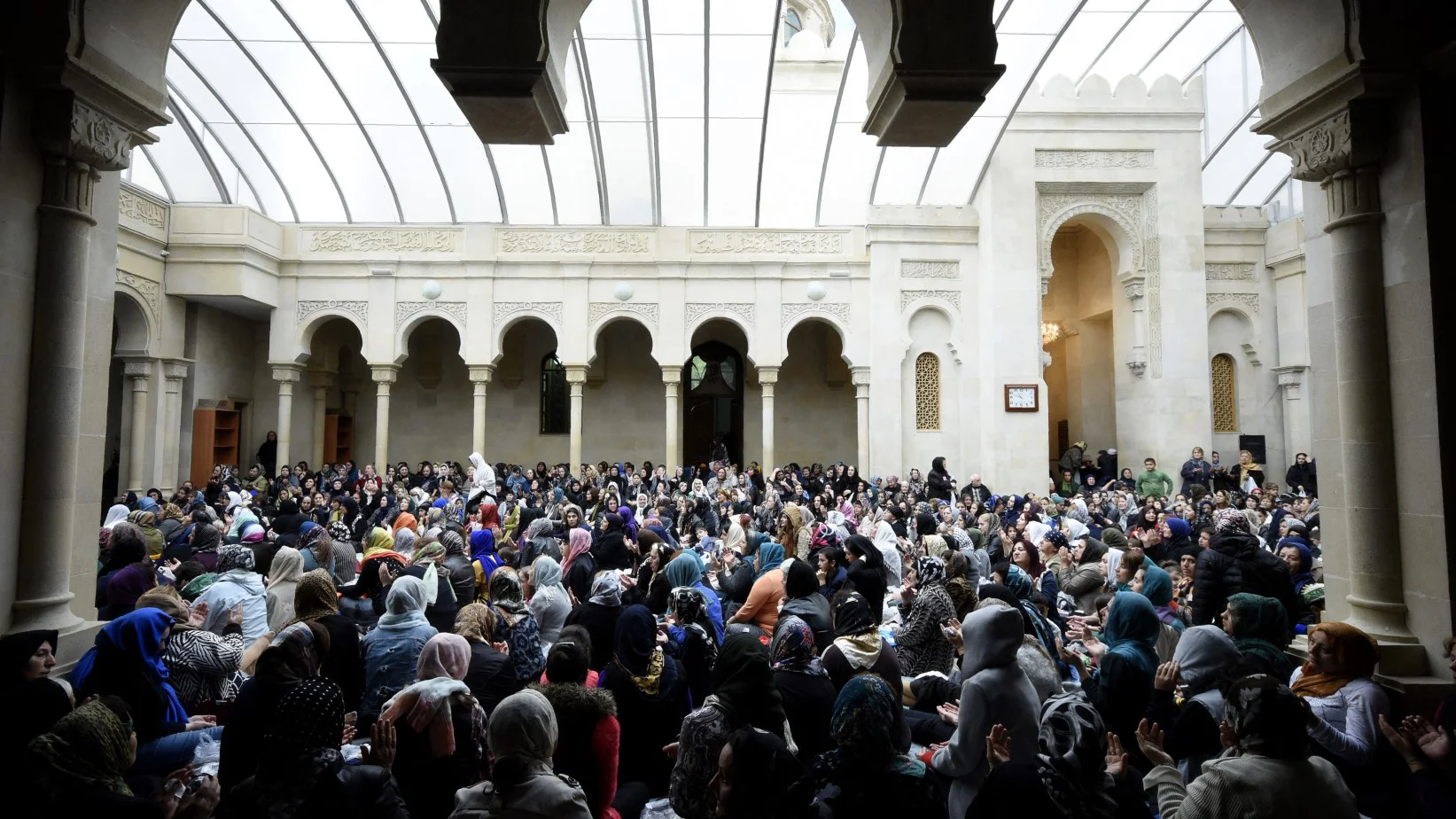
And yet Islam endured. When the state shut mosques and schools, families kept religious practice alive at home. Behind closed doors, grandmothers taught children the Fatiha and short suras, syllable by syllable, often in Arabic they could speak but not read. Prayers were learned by ear and passed on by voice. Children learned to keep that practice from school, where a stray remark could invite scrutiny of the family. A prayer mat might come out only after the door was locked.
Families wrapped Qurans that survived the closures and hid them in trunks, under floorboards and inside walls. Some could no longer read the books, but kept them as links to their dead and to a faith the authorities had forbidden them to teach. The girls now stopped at Baku’s school gates are descended from those families.
Religious life under official supervision
Even Stalin’s partial easing of anti-religious policy during the Second World War came with tight controls. In 1944, Soviet authorities established the Spiritual Administration of the Muslims of Transcaucasia in Baku to oversee officially permitted religious life. Its successor, the Caucasus Muslims Board, remains influential in Azerbaijan. Its chairman, Allahshukur Pashazadeh, has held the post since 1980. An institution created to manage religion under Soviet rule still occupies a central place in an independent country.
Women’s clothing became a public measure of the Soviet project to reshape society. Communist activists organised campaigns to remove the veil, presenting unveiling as both women’s emancipation and allegiance to the new order.
A century later, the setting and the institutions have changed. The assumption underneath has not: that authorities may decide how Muslim women appear in public. The parallel deserves scrutiny. When a state bars a girl from school because of her headscarf, it is hard to square that policy with a claim to be expanding her freedom.
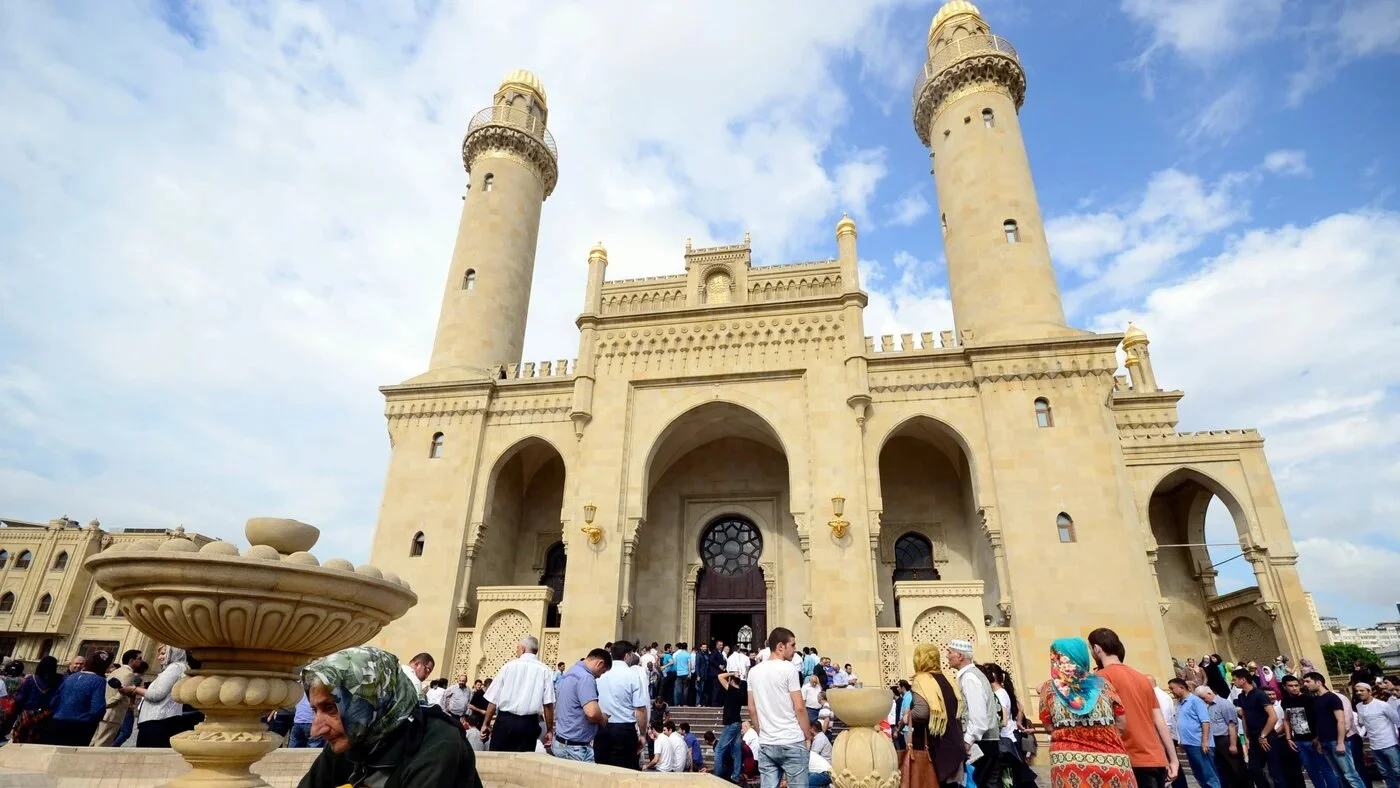
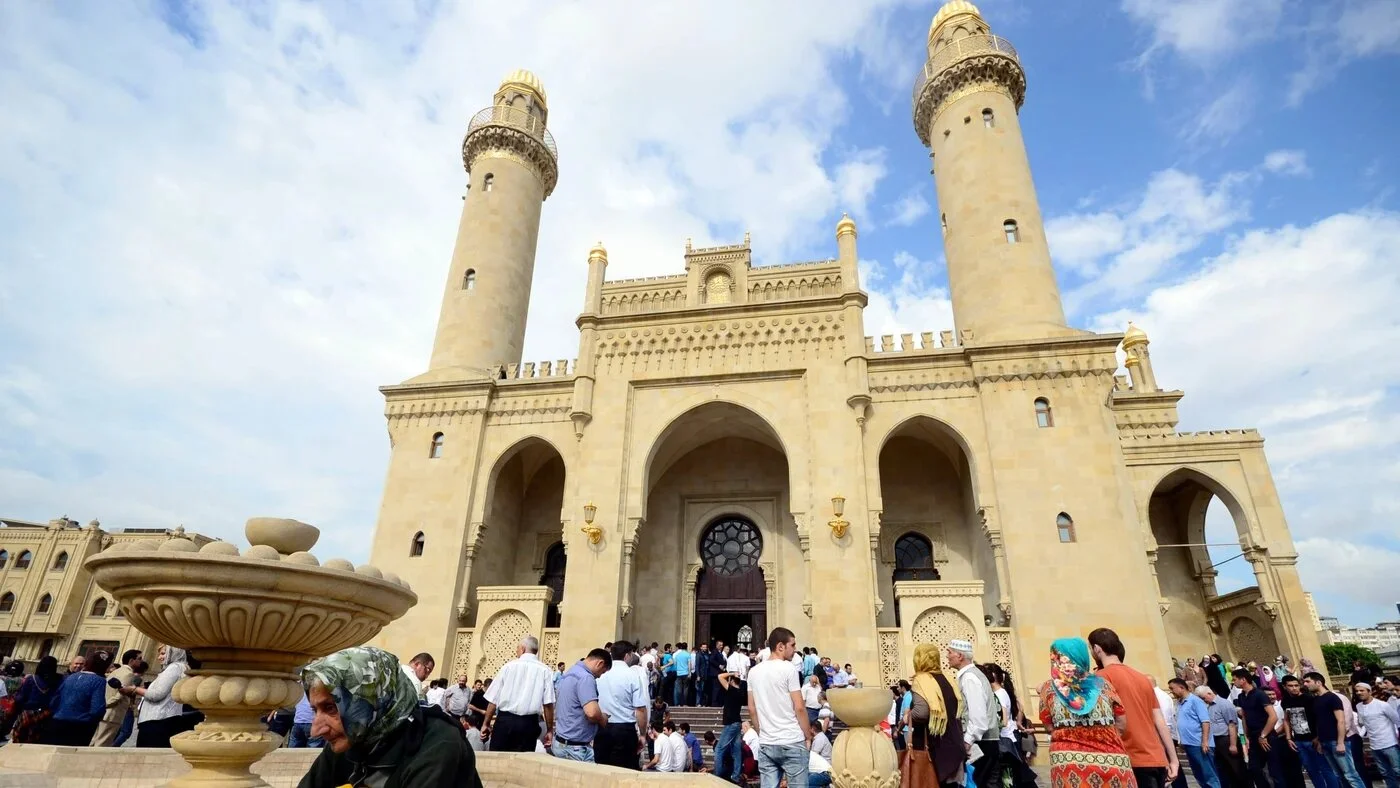
Muslim worshippers gather outside Taza Pir Mosque in Baku during Eid al-Fitr celebrations marking the end of Ramadan, 18 July 2015 (AFP)
The original report also links to the article by Soumaya Ghannoushi, published 19 October 2026 at 22:34 BST. Its subhead frames the argument as a century-spanning comparison between Bolshevik efforts to emancipate Muslim women by removing veils and the actions of Azerbaijan’s present-day political heirs.
Secularism can also police women
The inconsistency is hard to miss: Western governments and much of the Western media have offered little condemnation of Azerbaijan’s treatment of girls who wear headscarves. Azerbaijan supplies oil to Europe and Israel, and buys billions of dollars’ worth of weapons from Israel. If similar scenes played out in Iran, the outcry would likely be immediate. The apparent limit on women’s freedom is telling: they may choose to uncover, but covering draws far less defense.
That silence reflects a familiar Western story in which secularism stands for tolerance and democracy, while religion is cast as the natural home of authoritarianism. Azerbaijan complicates that neat division. A state can use secular ideals to impose its preferred way of life just as forcefully as a theocracy can impose religious rules.
History makes the point plainly. Stalin attacked mosques and churches in the name of scientific progress. In 1967, Enver Hoxha declared Albania the world’s first atheist state and then suppressed public worship with exceptional severity. Repression and ethnic cleansing have been carried out under religious banners and secular ones alike.
Modernisation by state command
Across parts of the region, governments invoke secularism, enlightenment and modernisation while intruding deeply into private belief. Their version of enlightenment comes with police enforcement: secularism becomes a rationale for state control over communities and individual choices.
Turkey offers an older example. Ataturk’s secularising reforms outlawed the fez, closed Sufi lodges and required the call to prayer to be delivered in Turkish. The state later barred headscarves in universities and public institutions; that ban was lifted only within the past 15 years. Many Muslim majority countries in the former Soviet south inherited a similarly coercive model.
Tajikistan’s 2024 ban on what officials called “alien clothing” was widely understood to target the hijab. Women have reportedly been stopped in the street and told to retie their headscarves in an approved national style. The rule’s reach is revealing: the state dictates not only whether a woman covers her hair, but how she must do it.
A century after the Bolsheviks set out to emancipate Muslim women by stripping them of their veils, their political heirs are still telling women what to wear
And yet religious practice has revived among women and young people despite these pressures. Governments now face a sustained conflict with their own societies, framed as a campaign for enlightenment and against extremism. The women resisting restrictions challenge its central assumption: that emancipation can be delivered from above. Students, teachers and professionals are asserting their right to define themselves, rather than fit the state’s model of the modern Muslim woman.
The Soviet empire is gone, but the faith it tried to extinguish has endured. In Azerbaijan, a dynasty that commands the country’s politics, wealth and institutions faces resistance from schoolgirls who will not uncover their hair. That is more than a dispute over dress. It exposes the coercion hidden inside a state’s claim to liberate.
The views expressed in this article belong to the author and do not necessarily reflect the editorial policy of Middle East Eye.


Discussion
Sign in to join the discussion.