Discover the intriguing story behind Willi Midelfart's mural in Oslo City Hall, revealing artistic rebellion and a hidden message in its design.
Oslo City Hall: A Visit Beyond the Surface
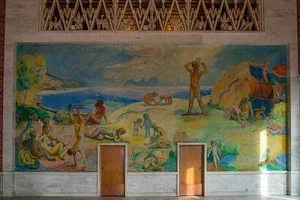
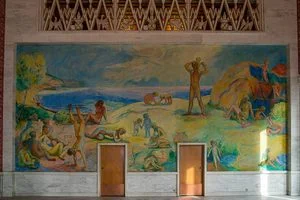
Oslo City Hall holds a prestigious place in cultural dialogues, particularly for its role in the annual Nobel Peace Prize ceremony. However, what’s often overshadowed in this iconic setting is the stunning fresco that decorates the second floor, Det gror. This vibrant piece serves as a concealed treasure, waiting to be unearthed by those willing to look beyond the usual tourist attractions.
The Architectural Significance of Oslo City Hall
Completed in 1950, Oslo City Hall is not just a venue for prestigious ceremonies; it’s an architectural statement. Designed in the functionalist style, the building incorporates classic elements with a dedication to accessible public art. The structure reflects a balance between utility and aesthetics, a characteristic often found in post-war Scandinavian architecture. The format of the building and its monumental towers symbolize Oslo's aspirations and democratic ethos.
Its walls house various artworks, but none resonates as deeply with visitors as the murals that capture the soul of Norwegian culture. Det gror stands out as a visual narrative, intertwining daily rituals with the serene beauty of nature. This kind of art elevates the mundane, ensuring that each experience in the hall is steeped in local history.
The Creation of Det gror
Commissioned in 1937, the artist Willi Midelfart took on the ambitious task of painting Det gror, a fresco that captures the vibrancy and essence of summer life in Holmsbu. Midelfart drew inspiration from Norway's artistic heritage, particularly from Edvard Munch, a titan of expressionism known for his compelling ability to convey emotion through color and form. With this influence, Midelfart created a tapestry of life that depicts families swimming, playing, and exploring the vast natural beauty surrounding them.
The mural is far more than an illustration; it’s a snapshot of everyday, joyful moments that resonate with anyone familiar with Norwegian summers. The sunlight filtering through trees, the laughter of children, and the calm waterways mirror a lifestyle that values simplicity and connection to nature. This reflects broader societal themes regarding family and community—a subject that bears relevance across generations.
A Hidden Rebellion
The creation of Det gror wasn't devoid of conflict, highlighting tensions often felt between vision and architectural realities. Initially, Midelfart had envisioned a singular door for his mural. However, an unexpected late addition of a second doorway mocked his artistic vision. This change didn't merely threaten the composition of the fresco; it provoked Midelfart’s irritation. In a sly act of defiance, he incorporated a boy into the painting who points to this new doorway while cheekily sticking out his tongue, a clever symbol of protest. This story fits into the larger narrative of artistic integrity clashing with pragmatic constraints.
Ironically, this added doorway remains bricked up—presumably a measure to preserve the mural's integrity. It stand as a metaphor for artists facing limitations and how they respond to upheaval in creative endeavors. The boy’s gesture serves as a silent yet potent critique, transforming a simple representation into a deeper dialogue about rebellion and adaptation. (and this is the part most people overlook) It suggests that art is often as much about the context in which it exists as it is about the artistry itself.
The Cultural and Artistic Implications
Looking at Oslo City Hall and Det gror, it’s clear that art can serve multiple purposes. It educates visitors, provides communal identity, and reflects cultural narratives—emphasizing the interplay between art and society. Midelfart's fresco challenges audiences to reflect on their own environment and the forces that shape it. In a broader sense, this reveals the intrinsic value of tapping into local art as a means of understanding a society’s ethos and values.
If you're working in this space, consider the power of place-based art and its potential influence on public perception. The story of Oslo City Hall illustrates how to engage communities in discussions that effect meaningful change. The interplay between artwork and architecture offers a compelling lens through which to view civic life, as well as the nuanced relationships that define cultural expressions around the world.
Significance and Future Outlook
Art like that found in Oslo City Hall serves an essential role beyond mere decoration; it invites ongoing discussion about the social norms and expectations tied to public space. Artists like Midelfart demonstrate how to capture local spirit while navigating the strictures imposed by surrounding structures. As we move towards a future where urban environments evolve, the lessons embedded in this fresco about coping with artistic limitations will remain valuable.
As urban centers continue to adapt, it’s vital for city planners and artists alike to explore innovative collaborations. Understanding the delicate balance between functionality and artistic freedom will be key. It can potentially lead to more inspired public spaces that resonate deeply with community identity. This can yield spaces where people not only pass through but pause, reflect, and connect.

Discussion
Sign in to join the discussion.