Recent research reveals France authorized 35 new military equipment sales to Israel, prompting protests from rights organizations and critics.
New Approvals for Military Equipment Sales
Between May and September 2026, France greenlit 35 military equipment exports to Israel, as disclosed by a joint investigation from the Palestinian Youth Movement and the French collective Urgence Palestine. This report highlights significant contradictions between the French government’s stated policies and the continuation of military trade amidst ongoing tensions in Gaza.
Details of the Equipment Shipped
The shipments reportedly included various components, such as cooling systems for tanks and missile launchers, alongside specialized gear like helmet visors for pilots. Notably, all items were intended for Elbit Systems, a key player in the Israeli defense sector, reinforcing concerns about the role of French technology in military operations.
Previous Reports and Context
These findings follow a prior investigation that revealed over 525 military shipments to Israel between October 2023 and March 2026. This earlier report drew attention to the transportation of significant military components, including 117 flights carrying F-35 fighter-jet parts originating from Roissy-Charles de Gaulle Airport.
Surveillance and Unanswered Questions
The latest inquiry identifies four additional suppliers, with 33 of the recent shipments also routed through CDG airport. Of these, a striking 32 shipments were handled by Israel's national airline, El Al. This logistical organization raises questions about the transparency of military exports sanctioned by the French government.
Protests and Political Backlash
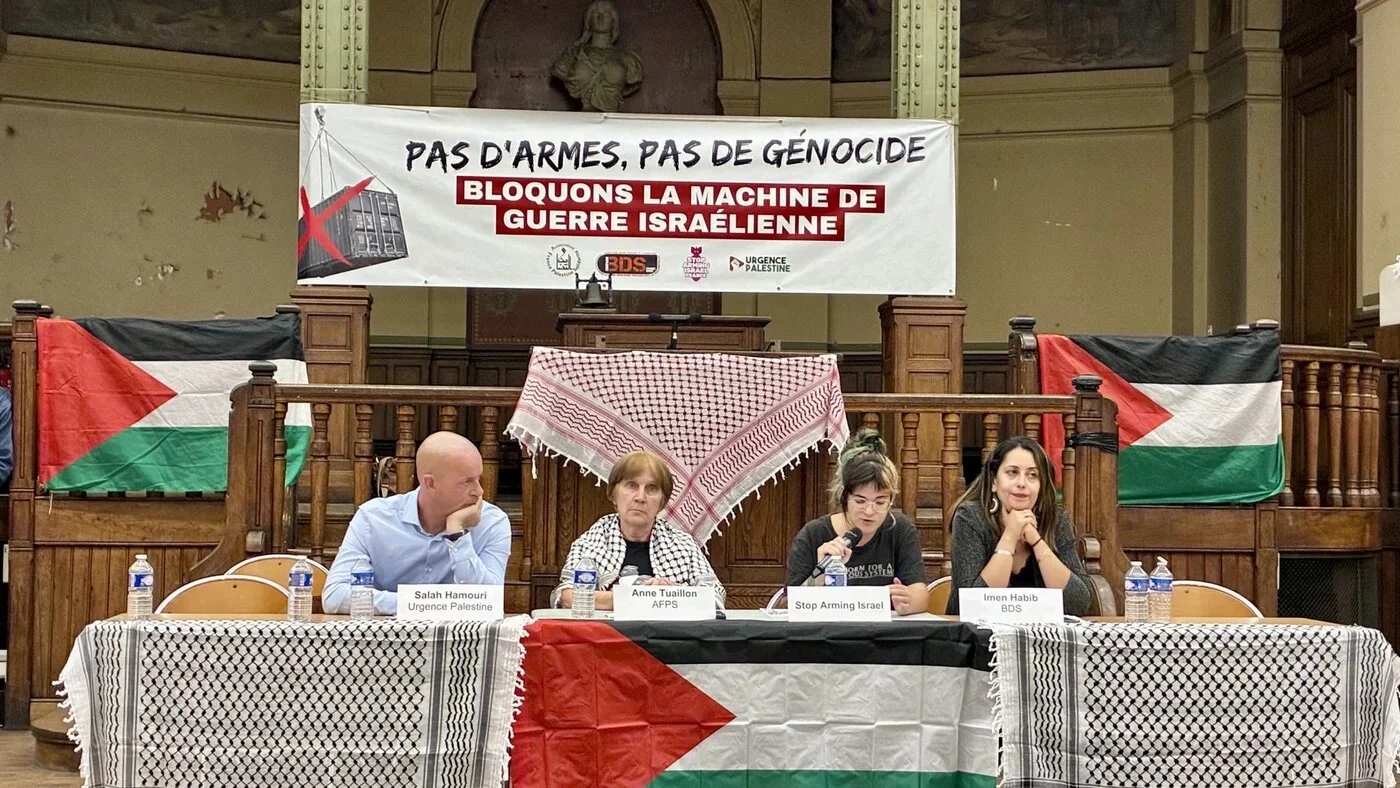
The report's launch coincided with the start of a month-long protest against French arms sales to Israel. The campaign, spearheaded by a coalition of trade unions and human rights groups, including BDS France and others, aims to amplify public awareness and resistance against ongoing military exports during a period of heightened violence in Gaza.
Criticism of Government Claims
Despite President Emmanuel Macron's statements at the UN condemning the situation in Gaza as a "spectacle that shames us all," critics underscore a growing hypocrisy in state behavior. Salah Hammouri, a French Palestinian human rights lawyer, pointed out the contradiction between the government's rhetoric and its actions, referencing the numerous military shipments that have taken place during the crisis.
“Macron says he is ashamed of the murderous spectacle offered by Israel. But he is not ashamed of having allowed 525 shipments of military components destined for Israeli factories.”
- Salah Hammouri, Human Rights Lawyer
Government's Position on Defense vs. Offense
The French government continues to assert that it has ceased selling "offensive" weapons to Israel, ostensibly limiting sales to "defensive" components. In a recent parliamentary session, French Defence Minister Catherine Vautrin reiterated that military exports approved are to support Israeli defense and ensure non-use against civilian targets.
Contradictions in Military Support
However, numerous NGOs have challenged this assertion, documenting continued deliveries of electronic systems and essential spare parts potentially interchangeable with offensive military utility. These critiques characterize exports of components as tacit support for Israel's military engagements, undermining the French government’s distinction between "offensive" and "defensive" equipment.
Legal and Ethical Implications
Concerned about the implications of these military exports, Thomas Nayla, a lawyer with Urgence Palestine, expressed skepticism regarding oversight mechanisms pertinent to transactions with Elbit Systems. He emphasized that items classified as "defensive" might very well constitute integral parts of offensive military systems, thereby questioning the ethical justification of allowing such exports.
“When you look at all the components that were sold - a cooling system for a tank, a visor for a helicopter pilot - there is no way these can be considered defensive.“
- Thomas Nayla, Lawyer at Urgence Palestine
Engaging Workers and the Public
As part of their campaign, Urgence Palestine aims to educate workers at companies involved in the manufacturing of these components. There’s a belief that awareness of the end-use of their products could lead to refusals to participate in such supply chains.
Nayla indicated that a portion of contacted companies acknowledged their involvement in these shipments, a factor that could play into broader community resistance against the military trade with Israel. The campaign envisions a collective effort involving civil society and political actors to challenge what they perceive as complicity in these military exports.
Conclusion: The Path Forward
During this month of protest, the coalition hopes to articulate actionable strategies and foster collaboration among unions, political figures, and citizens aimed at preventing further military support for Israel's military operations. The focus remains on leveraging public pressure to halt the flow of military components that, though labeled defensive, may facilitate ongoing violence in Gaza. This initiative reflects a broader call for systemic changes in countries complicit in arms trading, urging transparency and ethical accountability to restore peace and justice in the region.

Discussion
Sign in to join the discussion.