Though the idea seems plausible, sperm whales are unlikely to swallow a person whole, owing to their feeding habits and anatomy.
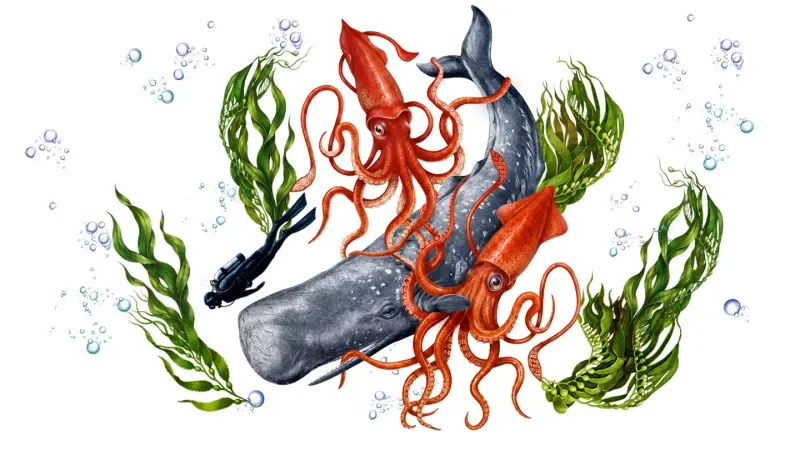
In the upcoming feature film Whalefall, scuba diver Jay Gardiner encounters an intriguing scenario when a sperm whale accidentally swallows him while pursuing a giant squid. This premise, although fictional, raises an intriguing question about the potential for such an incident to occur in reality.
According to Joy Reidenberg, a comparative anatomist at the Icahn School of Medicine at Mount Sinai in New York City and a consultant for the film, a very large male sperm whale could theoretically swallow a person. These whales can grow to lengths of over 18 meters, larger than what most people typically observe. This scale is key, as smaller whales wouldn’t possess the capacity to engulf a human.
In contrast, other whale species, such as the fin whale (Balaenoptera physalus), despite their impressive length of up to 26 meters, have a narrow gullet that poses a significant limitation. Reidenberg points out her firsthand knowledge through her work dissecting whale carcasses. “I can barely get my arm down the throat,” she emphasizes, highlighting the impracticality of a fin whale swallowing a human.
Fin whales belong to a group known as baleen whales, which feed primarily on tiny organisms like krill, small fish, and plankton. Utilizing baleen plates, they create a slurry similar to a thick milkshake, effectively sifting their prey from seawater. So, while a baleen whale might briefly catch a person in the process of feeding—as happened in 2019 to a wildlife photographer unexpectedly engulfed by a Bryde’s whale off the South African coast—such events aren't cases of deliberate consumption. “The whale is just trying to have dinner,” explains marine biologist Shane Gero, emphasizing that these encounters stem from accidental interference.
Sperm whales, however, have a very different diet, targeting formidable creatures like giant and colossal squid. The latter can reach lengths up to 14 meters, making such prey an understandable focus for these massive predators.
Research suggests that sperm whales likely employ a fascinating feeding mechanism. By maneuvering a specialized bone in their throat called the hyoid, they create a low-pressure environment that draws in both water and prey. This anatomical design, combined with their left-shifted larynx that broadens their throat, enables them to take in large gulps of food.
However, the intricacies of this feeding technique remain largely unstudied in sperm whales, and evidence shows they do not typically swallow their prey whole. As Gero notes, when sperm whales resurface with squid, “it’s either with literal chunks hanging out of their mouths or chunks floating behind them.”
Beyond their physical capacity, Reidenberg emphasizes that sperm whales are not naturally inclined to swallow humans, even if they could. Their interactions with people usually reflect gentle curiosity, rather than an aggressive appetite. Therefore, while the physiological potential for swallowing a person exists, the likelihood of it occurring is exceedingly low.
If accidental consumption seems implausible with sperm whales, it’s even less likely for divers. These whales can dive over two kilometers deep, far beyond the reach of typical human divers, making the odds of a casual underwater encounter exceedingly slim.
Interestingly, the only confirmed instance of an animal swallowing a human whole is the reticulated python (Python reticulatus), with several recorded cases in Indonesia. This feat is made possible by the snake's incredibly adaptable jaw structure, allowing them to engulf prey considerably larger than their head.
Yet, even for snakes, consuming a human is challenging. Biologist Bruce Jayne from the University of Cincinnati points out that the human anatomy—with broad shoulders and rigid limbs—can complicate the swallowing process. Consequently, while recorded observations of such incidents exist, they remain extraordinarily rare.
In essence, despite the compelling narratives portrayed in media, both whales and snakes exhibit behavioral patterns and anatomical constraints that render human ingestion an improbable event. The curiosity surrounding these topics may fuel fascination, but they reveal more about mythical storytelling than biological actuality.


Discussion
Sign in to join the discussion.