Riley Black's 'Tyrant Lizard Queen' redefines our understanding of T. rex, shifting the narrative from fearsome predator to complex survivor.
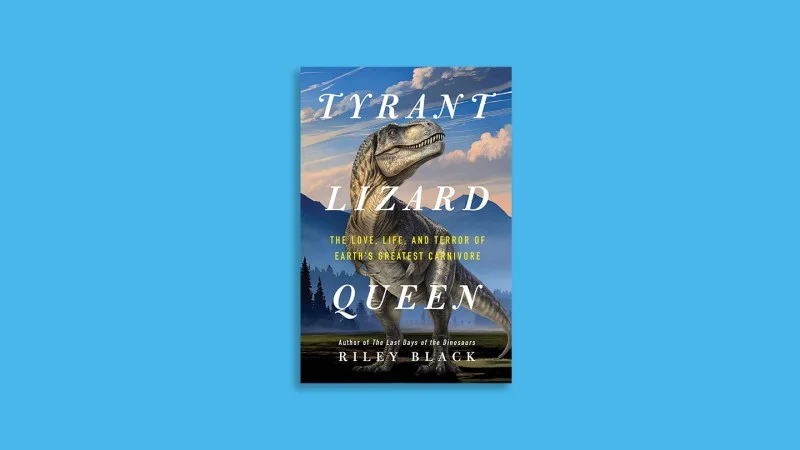
Tyrant Lizard Queen
Riley Black
St. Martin’s Press, $29.00
Reframing the Tyrant
The cultural portrayal of Tyrannosaurus rex often casts it as a terrifying villain—a giant predator up against everything from King Kong to unsuspecting children in SUVs. Museums contribute to this haunting image by showcasing formidable cast skeletons in action poses, captivating millions annually. The fascination with T. rex isn't just a reflection of its physical attributes; it stems from the stories we weave around it. But Riley Black challenges readers in Tyrant Lizard Queen to consider the realities behind this dinosaur’s fearsome reputation, urging us to look beyond the conventional narratives that have shaped our understanding of these ancient giants.
Snag’s Journey Through Prehistoric Perils
Within the book, we follow Snag, a fictional young T. rex in a prehistoric Utah forest. From the moment she hatches, danger looms; a pterosaur eliminates her siblings while an herbivorous Alamosaurus poses threats too, risking the lives of her remaining family. It's a stark reminder that survival is never guaranteed, even for the apex predator. This context flips the narrative on its head, transforming the predator into a vulnerable character and prompting readers to reconsider what it means to be a dominant species in a world fraught with peril.
Snag's story fits snugly into the coming-of-age genre, where her adventures are not merely about hunting and survival. She navigates rivalries and develops complex relationships, especially with Sweet, another female T. rex. Their initially competitive interactions evolve into a poignant connection, one that resonates with any reader who has wrestled with issues of rivalry and friendship. A notable event underscores the point—Snag's encounter with her own mate, who turns cannibalistic. This moment isn't just shocking; it's a reflection on the savagery found within survival itself. Can you imagine facing such betrayal from your own kind?
The Gaps in Our Understanding
Yet, the complexities surrounding Snag’s life extend beyond her immediate interactions. Understanding the behavioral intricacies of T. rex—how they played, slept, fought, and mated—remains elusive. Fossil records reveal limited information, leaving much open to interpretation. Black acknowledges these gaps, intending to flesh out the narrative with insights drawn from contemporary animal behavior—particularly from crocodilians and emus, their modern-day relatives. This approach bridges the gap between ancient and modern, illustrating how studying present species can inform our understanding of long-extinct animals.
In an enlightening appendix, Black offers a peek into her research methodology, revealing how diverse interpretations of the same skeleton reflect the uncertainties in paleontology. “No two visions of the same dinosaur are the same,” Black notes, emphasizing the subjectivity involved in reconstructing T. rex's life. This theme of uncertainty permeates the text, inviting readers to embrace the scientific process as one of continual questioning rather than definitive answers.
The Evolutionary Saga of T. rex
As the author depicts an underdog rather than a diva, she highlights the evolutionary saga spanning 80 million years that led to the emergence of this apex predator. The odds stacked against the ancestors of T. rex were dizzying. Black remarks on the "astounding" sequence of events that permitted such a creature to ascend to its celebrated status. But here’s the poignant takeaway: it isn’t just about what T. rex became; it’s about all the other life forms—both prey and predator—that existed alongside it, each battling against the same environmental forces.
In Snag’s narrative, complexity thrives; she is both a product and a shaper of her environment. Black illustrates how T. rex’s predatory behaviors compelled other dinosaurs to adapt, honing strategies of speed and defense. Conversely, the actions of prey species created the ecosystems necessary for T. rex to thrive. “Habitat changes the hunt,” Black states. “And the hunt changes the habitat.” This interplay showcases evolution not as a straightforward ladder but as a dynamic web of interactions.
Implications and Significance
Through Tyrant Lizard Queen, Black reincarnates T. rex beyond the stereotype of a simple carnivore, breathing life into the character while acknowledging the shadows of unanswered questions that accompany such an iconic creature. The nagging uncertainties surrounding T. rex are embraced throughout the narrative, fueling a longstanding curiosity about this remarkable beast. What's significant here is that Black doesn't shy away from these mysteries; she welcomes them, inviting readers to place themselves in the world of paleontology, filled with exploration and imagination.
Black aptly sums it up: “The core of paleontology is imagination. Dinosaurs thrive in the gaps our questions create.” If you're working in this space or just a curious reader, this imaginative approach provides a vital reminder. Understanding T. rex isn't simply about recounting facts or figures; it's about creating narratives that connect us to the past. And in doing so, Black doesn’t just make T. rex relatable—she makes it a symbol of the endless pursuit of knowledge.
Buy Tyrant Lizard Queen from Bookshop.org. Science News is a Bookshop.org affiliate and will earn a commission on purchases made from links in this article.


Discussion
Sign in to join the discussion.