A study of 143 hawkmoth species found three anatomical ways to make defensive ultrasound, with the adaptations evolving independently as many as seven times.
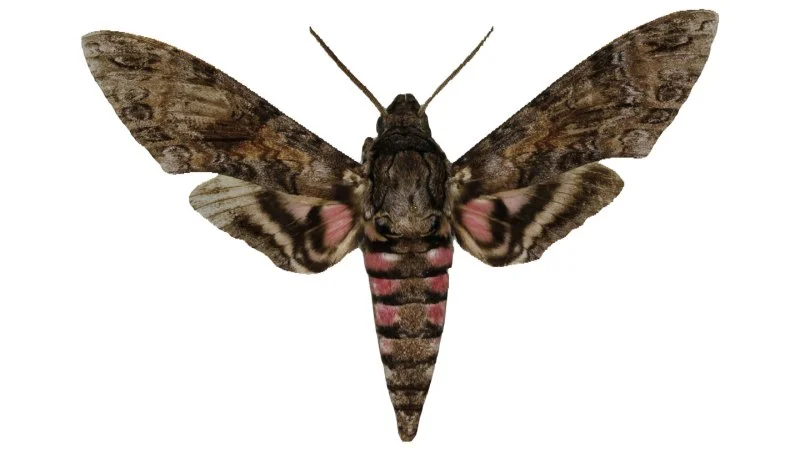
Hawkmoths answer sonar with sound
Hawkmoths have repeatedly developed their own acoustic defenses against bats. A study of 143 species found three ways males use specialized genital scales to produce ultrasound, suggesting the trait evolved independently at least four and possibly seven times over the past 5 million to 30 million years. The wide range in that estimate reflects uncertainty about how the sound-producing species are related and when their shared ancestors lived. Even so, the central finding is clear: these moths didn’t inherit one working design and keep it unchanged.
The sounds target bats’ echolocation, which predators rely on to find prey in the dark. A bat sends out calls and listens for returning echoes; noise from a moth can interfere with that process or affect how a predator responds to it. Hawkmoths’ varied mechanisms show how sustained predation can lead related species to arrive at similar defenses through different anatomical routes. This is more significant than it looks: the moths’ bodies appear to have reached a useful acoustic outcome more than once, using parts that also play a role in mating.
Three mechanisms, one set of scales
The research team recorded male moths responding to bat calls and examined preserved specimens with high-resolution imaging. Of the 143 species studied, 77 produced ultrasound. Each sound-producing species had enlarged, football-shaped scales on the male’s genital valves, structures that clasp females during mating. The scales make sound by scraping against different parts of the body. Recording the response and then inspecting the anatomy let the researchers connect particular sounds with the structures that produced them, rather than treating ultrasound as a single, uniform behavior.
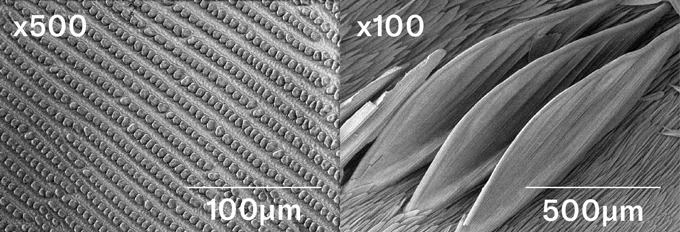
In one group, they scrape against a row of scales near the rear of the abdomen. In another, they rub against stiff spines along the abdomen’s edge. A third group drags them across a patch of microscopic bumps on the underside, a previously unidentified part of the sound-making system. The basic action is similar across these systems, but the surfaces differ—and that changes the kind of sound the moth can make.
Paul Masonick/Florida Museum of Natural History
Genital scales (right) of the jade hawkmoth (Daphnis hypothous) scrape against microscopic bumps on its abdomen (left) to generate ultrasound that helps foil bat attacks.Paul Masonick/Florida Museum of Natural History
The physical design shapes the sound. Scraping against spines or microscopic bumps tends to create more continuous noise, which may interfere with a bat’s sonar. Scale-on-scale friction produces less regular bursts that could startle a predator or resemble warning calls from unpleasant-tasting prey. The distinction matters because a sound can defend a moth in more than one way: it may complicate a bat’s attempt to locate it, or change the predator’s decision once an attack is underway.
The newly identified bumpy surface is associated with the widest range of sounds. Even close relatives can sound quite different, a flexibility that may leave those moths with more ways to adapt their defenses. Other lineages may be more limited by their anatomy, says evolutionary biologist Nick Dowdy of the Milwaukee Public Museum, who was not involved in the study. That potential flexibility remains an interpretation of the pattern, rather than proof that one mechanism provides better protection in every encounter.
Predation shaped the sound systems
Hawkmoths are among several insect groups known to make ultrasound when bats attack. Earlier research found this response in tiger moths, fruit-piercing moths, geometer moths and jewel caterpillar moths, as well as in some beetles and fireflies. Hawkmoths stand out for using genital scales as part of the mechanism. The family includes about 1,600 mostly nocturnal species; many hover at flowers while feeding. Their size as a family and varied habits make them a useful group for asking how a shared threat can produce different physical responses.
The new findings build on more than a decade of work by sensory ecologist Jesse Barber, now at the American Museum of Natural History, entomologist Akito Kawahara of the Florida Museum of Natural History, and their colleagues. The team focused on males because female sound production, although documented in some species, isn’t understood well enough for a systematic comparison. That boundary matters when interpreting the species count: the study maps male mechanisms, while leaving open how sound production in females fits into the broader picture.
The repeated evolution of these structures is a clear case of convergent adaptation: bat predation appears to have driven separate hawkmoth lineages toward similar acoustic defenses through different anatomical arrangements. But the pressure varies with how the moths live. Some lineages that shifted to twilight or daytime activity later lost their sound-producing structures. A defense can be useful only while the conditions that favor it persist.
“It’s been a major driver of insect evolution,” says evolutionary biologist Paul Masonick of the Florida Museum of Natural History. The changing sound systems suggest that hawkmoths’ nightly exchanges with bats have produced more than one route to survival—and that those defenses can disappear when the threat recedes. The systems are varied, and apparently reversible over evolutionary time.
What the findings leave open
The study offers a map of how male hawkmoths make ultrasound, but it doesn’t settle what each sound does to a bat in the wild. The proposed effects—interfering with sonar, startling a predator or signaling an unpleasant meal—aren’t interchangeable, and the anatomy alone can’t establish which matters most in a particular encounter. That’s a useful limit to keep in view when reading claims about the value of any one mechanism.
For researchers, the next question is how those sounds and body structures relate to actual outcomes during attacks, and how female sound production compares with the male systems examined here. If you’re working in this space, the study’s clearest lead is the variation itself: related moths can produce different sounds with different arrangements, while some lineages lose the structures when their activity shifts away from nighttime. The pattern points to a defense shaped by ecology, anatomy and changing exposure to predators.



Discussion
Sign in to join the discussion.