Low Danube levels can expose the remains of the Ferenc József Bridge, destroyed during the 1945 Siege of Budapest.
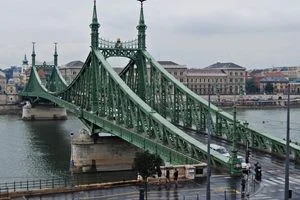
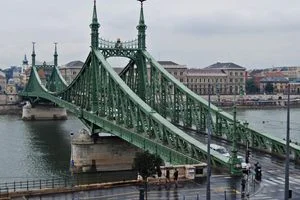
Budapest’s Liberty Bridge carries trams and pedestrians between Gellért Hill and the Central Market. It’s a working piece of city infrastructure, built into the everyday route across the Danube. When the river drops in summer, though, the bridge can also become a window onto an earlier crossing: sections of the Ferenc József Bridge, sometimes visible just beneath the surface or rising above it. The remains don’t appear on demand. Their visibility depends on how much water covers them, and a familiar commute can briefly acquire the quality of an archaeological site.
A bridge lost in the siege
The Ferenc József Bridge was destroyed during the Battle of Budapest in January 1945. On 16 January, a Soviet shell detonated German explosives that had been left on the bridge. The structure’s remains still lie in the river beneath the Liberty Bridge, which replaced it in 1946. That sequence gives the crossing a history measured not only in construction and transport, but also in destruction and reconstruction.
Bridges are easy to treat as permanent fixtures because their daily purpose is so immediate: they carry people and vehicles over an obstacle. In a city divided by a major river, a damaged crossing can disrupt movement and separate familiar routes. Rebuilding a bridge therefore restores more than a span over water. It reconnects parts of a city and gives residents a route back into ordinary routines, even when the new structure occupies the site of a violent loss.
The old bridge’s remains add a physical record to that history. They aren’t a memorial designed to be seen from the riverbank; most of the time, they’re hidden beneath the water. That makes their occasional appearance unusually direct. The past isn’t represented by a plaque or a photograph alone. It’s there in the broken frame, still occupying the riverbed below the bridge people use now.
What low water reveals
A river’s level changes how much of its bed is visible. When the Danube falls, objects that are usually submerged can emerge or sit closer to the surface. The effect can make the remains look newly discovered, even though they’ve been there since the earlier bridge was destroyed. A change in water level alters what people can see; it doesn’t alter the age of the object being revealed.
That distinction matters. A brief appearance can prompt questions about the bridge’s history, but it isn’t by itself a full account of conditions in the river. Visibility depends on the local shape of the riverbed and where the remains lie, as well as the water covering them. Similar submerged structures can be exposed unevenly, with one section visible while another stays out of sight. The scene is compelling, but it’s only one view of a larger site.
For people crossing the ornate green span, the wartime history usually sits out of view. Low river levels make it tangible, bringing the bridge’s broken frame back into sight. There’s an odd contrast in that moment: a functioning bridge above, the remains of its predecessor below. The city’s present and its damaged past occupy the same crossing, separated by water and decades.
And this is the part most people overlook: low water doesn’t simply reveal a historical object. It changes the relationship between that object and the people passing nearby. A structure that would otherwise be an abstract part of Budapest’s wartime history becomes something a pedestrian can notice from the current bridge. Briefly. Sometimes only from the right angle.
Climate, rivers and a cautious forecast
Hot, dry summers linked to climate change could make these appearances more common across Hungary and Europe. The wording matters: “could” describes a possibility, not a guarantee that the remains will be visible every summer or that each low-water episode has the same cause. River levels respond to conditions across a wider area, and a sighting at one bridge doesn’t establish a continent-wide pattern on its own.
Climate change can affect the conditions that shape heat and drought, while rivers also reflect rainfall and other factors across their watersheds. In practical terms, the connection between a hotter, drier summer and a visible piece of bridge may be indirect. Lower water can expose riverbed features; repeated or prolonged low-water conditions can make those exposures more noticeable. But the article’s central observation is narrower: the remains become visible when the Danube drops, and climate-linked hot, dry summers may make that happen more often.
This is more significant than it looks. The appearance of the old bridge offers a visible reminder that climate pressures and historical places can meet in ordinary city life. It also shows the limits of a dramatic image: one exposed structure can make a changing river feel immediate, but it can’t, by itself, tell us how often such conditions will occur or what they’ll mean for every river in Europe.
A living crossing with a buried past
The Liberty Bridge is both a route through Budapest and a marker of what happened to the crossing before it. Its replacement of the Ferenc József Bridge in 1946 tied the two structures together, while the remains beneath it preserve the difference between them: one carries traffic and pedestrians; the other survives as a broken form in the river. Their shared location makes the history unusually legible when water levels fall.
If you’re working in this space—whether you study cities, rivers or the way people encounter history—there’s a useful lesson here. Infrastructure’s past isn’t always confined to archives or designated heritage sites. Sometimes it remains embedded in the working environment, visible only when conditions change. That doesn’t make every low-water sighting a complete historical account. It does make the river itself part of how the story is experienced.
Here’s the thing: the remains don’t need to become a regular spectacle to matter. Their intermittent visibility already connects a present-day crossing to the destruction that preceded it, and to the rebuilding that followed. The Liberty Bridge carries the city onward. Below it, when the Danube allows, the older bridge briefly comes back into view. A fragment of history, exposed.


Discussion
Sign in to join the discussion.