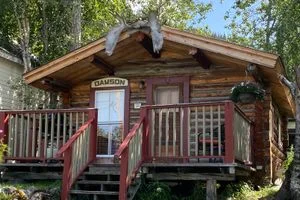
Dawson City's Gold Rush Cabin, a rare remnant of the Klondike era, has been meticulously restored, allowing visitors to experience its rich history overnight.
A Brief History
Dawson City's Gold Rush Cabin has a history that speaks to the heart of the Klondike Gold Rush era. Likely constructed around 1900, its origins intertwine with the activities of the Trading & Exploring Company during a time when hope and opportunity were as abundant as the gold that lured prospectors to the North. However, as the gold rush fizzled into a memory, Dawson City faced a dramatic decline. The once-thriving metropolis, once bustling with miners and adventurers, saw its population tumble. As residents departed in search of greener pastures, many structures succumbed to abandonment or were claimed by the elements. Yet, the Gold Rush Cabin stood resilient, a silent witness to the city's shifting fortunes, adapting to quieter periods by serving as a home for various inhabitants. This survival is significant, not just for its physical presence but for its representation of the dreams and struggles experienced during one of North America's most feverish treasure hunts.
Restoration Efforts
By the early 2000s, the Gold Rush Cabin’s fate hung in the balance. Its logs had suffered extensive damage, causing the structure to lean precariously, relying on a guy wire for stability—a precarious situation indeed. Recognizing its historical importance, a substantial restoration effort was initiated in 2005. This wasn’t a haphazard repair job. The cabin was painstakingly dismantled, with each log meticulously numbered to ensure authentic reassembly. The restoration team didn’t just seek to restore the cabin; they aimed to preserve its essence. Damaged sections were replaced using traditional splicing techniques, allowing for the incorporation of original materials wherever feasible. This attention to historical accuracy reflects a broader trend in heritage conservation, where authenticity is key, and modern techniques are often shunned in favor of methods that honor a structure's original craftsmanship. What this means for you if you're working in heritage or restoration is the realization that maintaining history often requires ingenuity and a deep respect for the past.
Historical Discoveries
The restoration process unearthed numerous historical artifacts that whisper stories of the cabin's past. Underneath its modern tin roof was evidence of an earlier sod roof, indicative of the building practices of the time. Logs displayed not just wear but scars from chimney fires, suggesting that this cabin was not merely a shelter—it was a lived-in home, filled with warmth and perhaps echoes of laughter. Hidden beneath the floorboards were treasures that included newspapers used as insulation. One poignant artifact, a poem entitled Despondency, captures a sentiment that might resonate with many faced with the harsh realities of frontier life. (And this is the part most people overlook)—these small items aren’t just clutter; they’re narratives. A piece of hand-painted wallpaper, also uncovered during restoration, harkens back to a time when the cabin might have been a lively hub of activity, indicating that its inhabitants sought beauty and comfort even in the wilderness. Such discoveries not only bolster the cabin's historical significance but also enrich our understanding of life during a pivotal era in North American history.
A New Chapter
With its restoration complete, the Gold Rush Cabin now stands as a proud landmark overlooking the Yukon River. It embodies more than just architectural significance; it serves as a repository of experiences and memories from a time long past. Uniquely, the cabin invites visitors to spend the night, offering an immersive experience that connects them with the region's gold rush history—an opportunity that feels increasingly rare in a rapidly changing world. Imagine falling asleep with the whispers of the Yukon outside, the same river that once guided countless hopes and dreams. For those curious about the Klondike’s storied past, this isn’t just another historical site; it’s a living museum, providing a tangible link to a vibrant chapter of human ambition and resilience.
Implications and Future Outlook
The careful restoration of the Gold Rush Cabin underscores a growing appreciation for historical preservation in the face of modernization. As society acknowledges the richness of its past, such projects will likely gain momentum, inspiring similar initiatives worldwide. This blend of nostalgia and practicality may prove effective in reviving interest in heritage tourism, which can contribute positively to local economies. Additionally, the decisions made in restoring structures like this cabin may influence how other historical sites are approached—balancing the delicate act of preservation with the necessity of practicality. As more visitors show interest in authentic experiences rather than mere representations, the cabin offers a model for future projects aiming to bridge the gap between history and modern engagement. So, if you're in the field of tourism or heritage conservation, take notes: the Gold Rush Cabin may just be leading the way into how we interact with our shared history.


Discussion
Sign in to join the discussion.